

08 Aug c. What are major Hindu scriptures?
Hinduism has a long line of scriptural traditions that continue to evolve to this day.
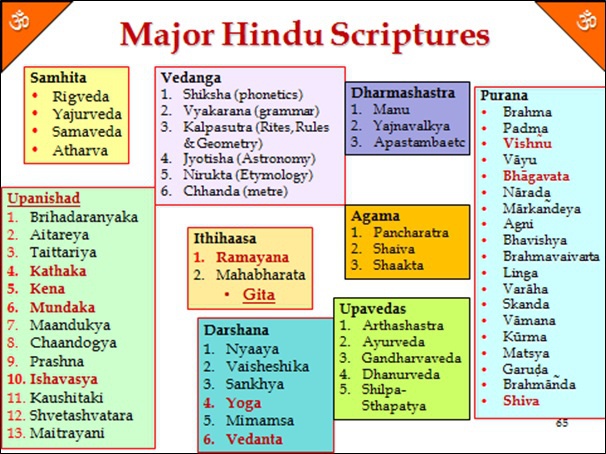
Hinduism’s core scriptures are Shruti (that which is heard, eg. Vedas), Smriti (that which is remembered, Manusmriti), Itihasa (Ramayana and Mahabharata) and Puranas. The Upanishads are also Shruti, which are sublime philosophical meditations on the nature of reality, the Self (Atma), and the permanent and unchanging Brahman (Divinity/God/God substance). Within the Mahabharata is actually contained the Bhagavad Gita, perhaps the text most familiar to non-Indians/Hindus, which describes paths for liberation and also elaborates on both righteous duty (dharma) and the states of detachment (vairagya) under which such duty needs to be undertaken.
Even after these original scriptures were composed, Hindus continued to create new variants. The Ramayana itself has been adapted multiple times with minor and major variations, including in Hindi as the Ramacharitmanas of Tulsidas. Many other religious texts have developed in various sampradayas, panths, maths, and other religious organizations which are too numerous and substantial to summarize here.
The Hindu corpus is alive, not just through the reinterpretation of old scriptures but in the writing of new scriptures.
Contributors: Madhukar Adi & Raman Khanna
Location of this post (7c): https://www.hinduspeakers.org/ufaqs/what-are-major-hindu-scriptures/
Sorry, the comment form is closed at this time.