Simple answers to your questions on Hinduism are provided here.
Use the search button (top right on desktop, top left on smartphones) to find specific topics of interest. At the bottom of each answer, check the “Tags” section for related topics. To learn more about this Q&A project, click [here].


On Hinduism
You can also download an earlier collection: 300QAs on Hinduism (PDF). Thank you.
18. Hindu Practices
Worship comes in many forms and frequency to Hindus. The “form” a Hindu chooses to express his/her piety through, or the deity that best represents the aspects of divinity that appeals to an individual, influences the nature of worship. Therefore, the reverence for places, objects, sages, seers, mantras, or even the denial of forms towards spirituality marks an influence on a Hindu’s approach to worship. If a Hindu considers Sun to be essential for life on this planet and sees the causation, chances are that (s)he will fold hands in gratitude every sunrise and sunset. If a Hindu sees a river as sacred for the life it has sustained for thousands of years, (s)he may aspire to take a dip in it once in his/her life. If a certain alignment of Moon and Sun, which can raise tides in the ocean, does something to the energies of an individual he’d want to remember to take a pause and think of it, perhaps with folded hands or sitting in silence. To another Hindu every breath may be worship, and to yet another worship may not be necessary at all. How often – as often as you want, or not at all. Some Hindus worship daily during festivals. Quite a few Hindu homes have a consecrated deity that they worship daily.
Other reading material: Short answers to real questions about Hinduism; Worship in Sanatana Dharma:
Relevant videos:
Contributor: Rajeev Singh
Location of this post (18a): https://www.hinduspeakers.org/ufaqs/how-often-is-a-hindu-supposed-to-pray/
Category:
18. Hindu Practices
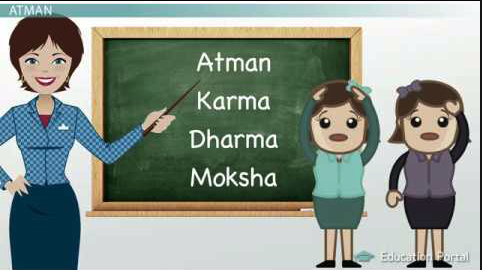
In general Namaste means, “Greetings” or “Hello” or “How are you”. It is just a way of greeting people. However, technically speaking, Namaste is made up of two words, Namaha + Te. Namaha means ‘I bow’. Te means ‘You’. Hinduism teaches us that God is sitting inside us, that is your soul or Atman. Namaste means I see divine in you and bow to you.
.
Other reading material:
Relevant videos: HAF: Namaste – Simply Divine,
Contributor: Dr. Jyoti Lulla
Location of this post (18b): https://www.hinduspeakers.org/ufaqs/namaste-what-does-it-mean/
Return back to FAQ.
Category:
18. Hindu Practices
Hindus who choose to go to temples or have a temple at home, offering food is an approach to strengthen devotion. For others it is the aspect of giving something of importance, which strengthens their material detachment. To others it is the solace of donating food that can be used for feeding the temple priests or even the poor and the hungry. Hinduism permits different vehicles of piety, practices and devotion. Offering food, with many different motivations behind it, is yet another example of the many vehicles of devotion that Hindus choose.
Hindus can offer water, leaves, fruits or flowers as an expression of their devotion. That which comes from the divine is being offered back as prasad–this is an important way to remember the source of all material opulence.
It is important to recognize that not all Hindus go to temples nor all Hindus believe in going to temples. In fact, there are schools of thought within Hinduism that do not have temples or don’t believing in offering to any deity.
Other reading material: What is prasad?
Relevant videos:
Contributor: Rajeev Singh
Location of this post (18c): https://www.hinduspeakers.org/ufaqs/why-do-you-give-food-to-god-idols/
Category:
18. Hindu Practices
Lamps were the only source of artificial light in olden days. Consider a dark room, where God, a symbol/representation of the divine, is placed (in the sanctum of temples). The priest shows a lamp in the form of Aarathi close to the murti. The purpose is to make sure the picture is registered in our minds.
Light represents knowledge. When praying we are saying that the Lord gives me enough knowledge all the time.
Other reading material:
Relevant videos:
Contributor: Dr. Jyoti Lulla
Location of this post (18d): https://www.hinduspeakers.org/ufaqs/why-do-you-use-light-aarti-to-pray/
Category:
18. Hindu Practices
The red dot is called a bindi. The bindi can be in different colors and shapes. Here are a few reasons for wearing a bindi:
- The bindi is associated with the worship of the Ultimate Reality as the feminine divine.
- It is also indicative of the conceptual “third eye of spiritual wisdom”, as Shiva, the greatest of Yogis, is depicted as having.
- It is regarded to be the symbol of being a Hindu woman. A married Hindu woman puts a bindi along with vermillion (sindoor) on her forehead.
- It is believed to restore concentration of the mind. Hindus think of the midpoint of the forehead between the eyebrows as the zone of wisdom.
- It is a beauty mark during festivals or rituals such as the Holi and wedding ceremony.
- The male version of forehead markings is called a tilak and can be made of kumkum, sandalwood or sacred ash. It is applied in a variety of shapes including lines, U-shapes and dots. The tilak is a representation of the school of philosophy and divinity that an individual subscribes to..
.
Other reading material: Short answers to real questions about Hinduism, Sharma, S, 2013, Hinduism for Kids: Beliefs and Practices
Relevant videos:
Contributor: Monita Sharma
Location of this post (18e): https://www.hinduspeakers.org/ufaqs/what-is-the-red-dot-many-hindu-women-wear-on-their-forehead/
Category:
18. Hindu Practices
Swastika is a symbol of divinity for Hindus, Jains, and Buddhists. It is a symbol to represent well-being, the good, and the auspicious. While the use of this symbol has existed for at least 10,000 years across ancient Europe, the Middle East, Africa, China and the Indian Subcontinent, today it is primarily found in active use in India, China, Korea, and Japan.
This is a universal symbol that exists in every culture of the world. It represents many of nature’s phenomena; blooming of flowers, rotation of the Big Dipper constellation around Polaris as viewed from mid-northern latitudes.
The word Swastika originated from the root word Swasti which means may you be well. The four arms of the Swastika symbolize the four main directions: North, South, East, West. Also the four Vedas: Rig, Atharva, Yajur, and Sama, the four aims of human life (Purusharthas): Dharma, Artha, Kama, and Moksha, and the four stages of life (ashramas): Brahmacharya, Grihastha, Vanaprastha, and Sannyas.
In a 2008 Hindu-Jewish leadership summit the Chief Rabbinate of Israel had recognised that the Swastika has been sacred to Hindus for a millennia prior to its misappropriation. Swastika should not be confused with Nazi’s Haken Kreuz (hooked cross).
.
Other reading material: What is meaning of the Swastika?
Relevant videos: BBC Podcast: Reclaiming the Swastika, Importance of Swastika in Hinduism-Artha,
Contributor: Rajeev Singh
Location of this post (18f): https://www.hinduspeakers.org/ufaqs/what-is-the-meaning-of-the-swastika/
Category:
18. Hindu Practices
The time-honored Saṃskrta word Saṃskāra (Samskar or Sanskar) has a number of different meanings such as making perfect, refining, polishing, training, cultivation, molding, etc. All these meanings point in the direction of betterment. A saṃskāra takes a living being or even an inanimate object to a higher state of existence.
The etymology of this word in Samskrta is–Samyak kriyate anena karmanā, iti Saṃskārah – सम्यक् क्रियते अनेन कर्मणा इति संस्कारः (The ceremony which imparts the quality of appropriateness is a Saṃskāra). Saṃskāras make lasting impressions and channel our thoughts and actions in the direction of refinement.
Samskara is an vedic ritual that literally implies making someone eligible for doing something that he/she isnt before the samskara. For example: Annaprasana makes the child ready to start eating rice/solid food graduating from living off its mother’s milk. Similarly, Upanayan samskara makes the person eligible for learning vedas.
The closest English word to “saṃskāra” is “sacrament”, thought the English word has many limitations.
Source: The book Vivāha Saṃ̣skāra: The Hindu Wedding Ceremony.
Other reading material:
Relevant videos:
Contributor: Dilip Amin
URL of this page (18h): hinduspeakers.org/ufaqs/what-is-samskara-or-sacrament-in-hinduism/
Category:
18. Hindu Practices
Samskaras (Sanskar) are vedic rituals performed at various stages of a Hindu’s life – some are performed by parents, others by self, and last ones by progeny.
Hindu society, since its emergence, has invested in the concept of saṃskāra, for the sake of its smooth functioning. The sages have prescribed that during the lifetime of a human being, several saṃskāras be performed. They envisioned human life as a progression of several stages of physical, psychological, social and spiritual advancement and ordained that appropriate saṃskāras be performed to mark the onset of each stage to make a lasting impression on the mind. Below are the 16 saṃskāras that signify the passage of a Hindu from one stage of the life to the next.
1 Garbhādhānam: Establishment of fetus, i.e. consummation of marriage
2 Puṃsavanam: In pregnancy (2nd or 3rd mo.)
3 Sīmantonnayanam: In pregnancy (6th or 7th mo.) (video)
4 Jātakarma: At birth ceremony. Praying for the child’s intelligence.
5 Nāmakaraṇam: Naming ceremony. Around the 12th day
6 Niskramaṇam: Child’s first outing. Around 2 to 4 months
7 Annaprāśanam: First feeding of solid food Around 6 months
8 Cūdā(Chauda) karma: Child’s first haircut (tonsure) as an offering to Īśvara
9 Vidyārambhah: Beginning of education – learning to read and write
10 Upanayanam: Taking the child to a Guru Sacred thread ceremony. Around 7 to 12 years
11 Vedārambhah: Start learning the Vedas or formal education
12 Samāvartanam: Graduation, return home
13 Vivāhah: Wedding
14 Vānaprasthah: Withdrawal from the duties of the householder stage of life
15 Saṃnyāsah: Renunciation
16 Antyestih: Final rites – cremation
Source: The book Vivāha Saṃ̣skāra: The Hindu Wedding Ceremony.
Other reading material:
Relevant videos:
Author: Dilip Amin
Location of this post (18h): https://www.hinduspeakers.org/ufaqs/what-are-16-samskaras/
Category:
18. Hindu Practices
Offering food to God is an expression of devotion and gratitude. For some, it represents giving up something valuable, which helps cultivate detachment from material possessions. For others, it is a way of sharing—since the food offered is later distributed to temple priests, devotees, and often to the poor and hungry.
Hinduism provides many pathways for devotion (bhakti), and offering food is one such practice. Once offered, the food is believed to be sanctified and imbued with divine blessings. This blessed food is then shared as prasāda—a sacred gift from the Divine.
Other reading material:
Relevant videos: The Kerala Story,
Contributor: Dilip Amin
Location of this post (18i): https://www.hinduspeakers.org/ufaqs/what-is-prasad/
Category:
18. Hindu Practices