Simple answers to your questions on Hinduism are provided here.
Use the search button (top right on desktop, top left on smartphones) to find specific topics of interest. At the bottom of each answer, check the “Tags” section for related topics. To learn more about this Q&A project, click [here].


On Hinduism
You can also download an earlier collection: 300QAs on Hinduism (PDF). Thank you.
18. Hindu Practices
The time-honored Saṃskrta word Saṃskāra (Samskar or Sanskar) has a number of different meanings such as making perfect, refining, polishing, training, cultivation, molding, etc. All these meanings point in the direction of betterment. A saṃskāra takes a living being or even an inanimate object to a higher state of existence.
The etymology of this word in Samskrta is–Samyak kriyate anena karmanā, iti Saṃskārah – सम्यक् क्रियते अनेन कर्मणा इति संस्कारः (The ceremony which imparts the quality of appropriateness is a Saṃskāra). Saṃskāras make lasting impressions and channel our thoughts and actions in the direction of refinement.
Samskara is an vedic ritual that literally implies making someone eligible for doing something that he/she isnt before the samskara. For example: Annaprasana makes the child ready to start eating rice/solid food graduating from living off its mother’s milk. Similarly, Upanayan samskara makes the person eligible for learning vedas.
The closest English word to “saṃskāra” is “sacrament”, thought the English word has many limitations.
Source: The book Vivāha Saṃ̣skāra: The Hindu Wedding Ceremony.
Other reading material:
Relevant videos:
Contributor: Dilip Amin
URL of this page (18h): hinduspeakers.org/ufaqs/what-is-samskara-or-sacrament-in-hinduism/
Category:
18. Hindu Practices
Samskaras (Sanskar) are vedic rituals performed at various stages of a Hindu’s life – some are performed by parents, others by self, and last ones by progeny.
Hindu society, since its emergence, has invested in the concept of saṃskāra, for the sake of its smooth functioning. The sages have prescribed that during the lifetime of a human being, several saṃskāras be performed. They envisioned human life as a progression of several stages of physical, psychological, social and spiritual advancement and ordained that appropriate saṃskāras be performed to mark the onset of each stage to make a lasting impression on the mind. Below are the 16 saṃskāras that signify the passage of a Hindu from one stage of the life to the next.
1 Garbhādhānam: Establishment of fetus, i.e. consummation of marriage
2 Puṃsavanam: In pregnancy (2nd or 3rd mo.)
3 Sīmantonnayanam: In pregnancy (6th or 7th mo.) (video)
4 Jātakarma: At birth ceremony. Praying for the child’s intelligence.
5 Nāmakaraṇam: Naming ceremony. Around the 12th day
6 Niskramaṇam: Child’s first outing. Around 2 to 4 months
7 Annaprāśanam: First feeding of solid food Around 6 months
8 Cūdā(Chauda) karma: Child’s first haircut (tonsure) as an offering to Īśvara
9 Vidyārambhah: Beginning of education – learning to read and write
10 Upanayanam: Taking the child to a Guru Sacred thread ceremony. Around 7 to 12 years
11 Vedārambhah: Start learning the Vedas or formal education
12 Samāvartanam: Graduation, return home
13 Vivāhah: Wedding
14 Vānaprasthah: Withdrawal from the duties of the householder stage of life
15 Saṃnyāsah: Renunciation
16 Antyestih: Final rites – cremation
Source: The book Vivāha Saṃ̣skāra: The Hindu Wedding Ceremony.
Other reading material:
Relevant videos:
Author: Dilip Amin
Location of this post (18h): https://www.hinduspeakers.org/ufaqs/what-are-16-samskaras/
Category:
18. Hindu Practices
26. Marriages
The Hindu wedding, called Vivaha, is the most important samskara (sacrament, rite of passage) of Hindu life. Hindu weddings are colorful and elaborate extending to several days. Prior to the wedding day, there are mehdi (hand painting), a music festival, Garba dance programs, and more.
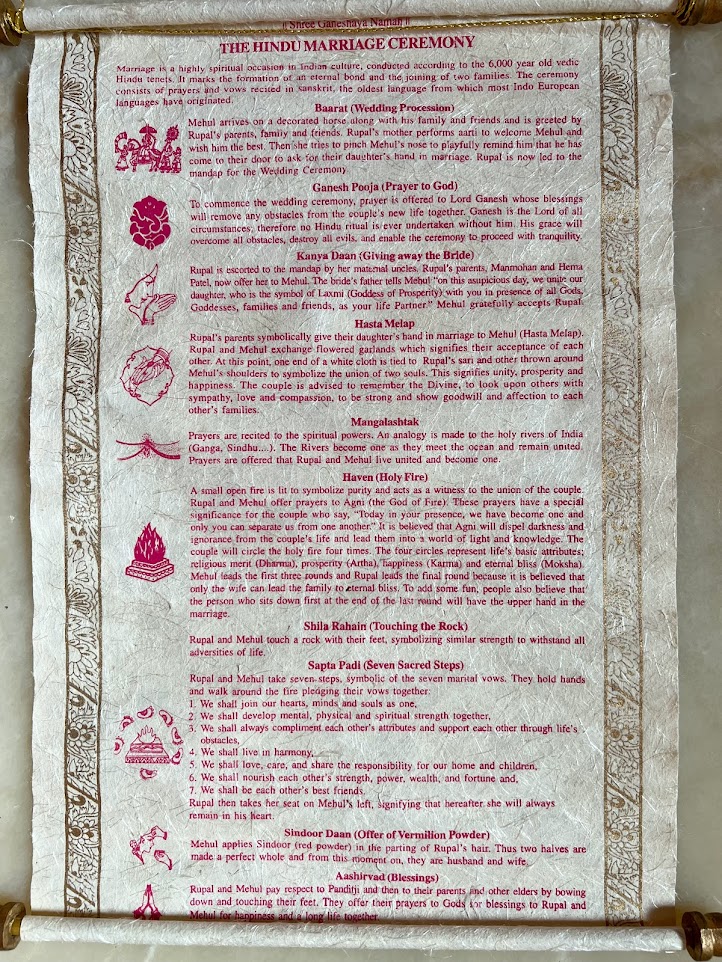
On the wedding day, the groom and family arrive at the bride’s home. The groom is considered to be an incarnation of Lord Vishnu. The bride, considered to be an incarnation of Goddess Lakshmi, arrives at the venue with her maternal uncle. At the beginning of any Hindu religious ceremony, Lord Ganesha’s blessings are sought as He is the remover of all obstacles. The groom adorns the bride’s neck with a necklace called mangala-sūtra i.e. auspicious thread. The ends of the sari worn by the bride and the shawl worn by the groom are formally tied. It has the symbolic meaning of tying two lives together. There is a homa (offerings to Agni) where the couple is seeking Agni’s blessing. Then there is Saptapadih, the seven-step circumambulations around Agni (fire), which is recognized as the essence of a Hindu wedding. These are Saptapadih oaths:
1. Be a provider of food in abundance
2. Bring vigor and energy to the household
3. Be a harbinger of prosperity to the family
4. Always bring comfort to the household
5. Have many children together with the husband
6. Enjoy with him all that the seasons have to offer
7. Become his true and unwavering friend for life.
Source: The book Vivāha Saṃ̣skāra: The Hindu Wedding Ceremony.
Other reading material:
Relevant videos:Hindu wedding, Fusion Hindu wedding,
Location of this post (26c): hinduspeakers.org/ufaqs/what-is-a-hindu-wedding-like/
Category:
26. Marriages