Simple answers to your questions on Hinduism are provided here.
Use the search button (top right on desktop, top left on smartphones) to find specific topics of interest. At the bottom of each answer, check the “Tags” section for related topics. To learn more about this Q&A project, click [here].


On Hinduism
You can also download an earlier collection: 300QAs on Hinduism (PDF). Thank you.

01. God Concept
Hindus have a very modern relationship with Divinity. We know that the one single divinity, that pervades everything and everyone, can be known to our hearts in our own unique ways.
I will answer your question, but first I must ask–what is the color of your car? (assuming the answer isn’t “Black”. If they say Black, just ask another person that doesn’t have a black car).
So you have a Silver colored car? Did you pick it yourself? Why? Because you liked it!! Surely you liked the Black car as well?
Hindus have many expressions of divinity. You may translate these roughly into “gods”, but that is just a mis-translation. We have many expressions of divinity, and so you can say that Hindus are poly-theistic. That would only be partially right because usually, polytheism relates to the Roman/Greek pantheon of warring gods that are always at odds with each other. The Hindus don’t approach divinity in the same manner.
Now let me tell you the story of Mister Ford. He invented the modern factory, making automobile cars cheaply through his use of the conveyor belt. He was very famous, as I am sure you know, but he had some detractors. You see, some people didn’t want black cars. Why did they have a problem with our Mister Ford? He didn’t want to sell them colored cars. His Model-T car was only available in Black because he didn’t want to stop his conveyor belt to change the color of the car. So he declared that “people can have ANY color of car they want, as long as the color is BLACK”.
This Model-T-ism is the state of today’s monotheism. “You may have only one God as-long-as he is a white-bearded old man who is somewhat grumpy and gets angry at times”. That monochrome monoculture may work for those religions that spring from sparse ecologies but denies the obvious richness and variety that all creation represents.
To recap, Hindus have a much more modern relationship with God. We know that the one single divinity that pervades everything and everyone can be known to our hearts in our own unique ways. Whatever conception of divinity is dearest to us, Hindus believe that the idea of their chosen deity (Ishta devata) is the god (or deva) they will pray to.
Some hearts want a silver car, and they should have the ability to drive a silver car, wouldn’t you agree? Why should all of us have to deal with the Model-T-ism of divinity?
Other reading material:
Relevant videos: Swami Nikhil Anand , Dilip Amin,
Contributor: Gaurav Rastogi
Location of this post (1c): https://www.hinduspeakers.org/ufaqs/is-hinduism-a-polytheist-religion/
Category:
01. God Concept
Hinduism does not conform to the archetypal definitions of monotheism or monism, even while maintaining the “only one God” framework.
Religions are generally classified as monotheistic, polytheistic, monistic, etc. Hinduism differs markedly from the predominant monotheism (there is only one true God, there are other not true “gods” or belief systems) of the Western religions (Christianity, Islam, Judaism), in which God is held to be both the creator of the world and ‘above and independent’ of it (meaning there are two separate entities).
Hinduism is classified as Eastern Monism or Advaita (Advait = not-two-ism) Monism. Most Hindus (though not all, Dvaita School for example) believe in monism, the idea that all reality ultimately has one foundational commonality upon which are the layered expressions that we see as differences. For example, the ocean, clouds, snow, rivers and lakes may look different but all are ultimately H2O.
Monists believe that similarity of forms of reality–gods and goddess, plants and animals, the material universe, and humans–share a common foundational essence. Hindus call this essence of Brahman, which is one.
Monism as a word and concept has meanings that are different from the above, as a result Hinduism, Sikhism, and large parts of Mahayana Buddhism had to be classified under the term Eastern Monism or Advaita Monism.
David Hume (1711-1776) argues that monotheism is less pluralistic and thus less tolerant, because monotheism stipulates that people pigeonhole their beliefs into one tenet.
Other reading material: https://houseoflac.wordpress.com/2018/05/08/theisms-and-sanatan-dharma/
Relevant videos
Contributor: Dilip Amin, Sandeep Tiwari
Location of this post (1i):: https://www.hinduspeakers.org/ufaqs/are-hindus-monotheistic-or-monist/
Category:
01. God Concept
02. God Forms
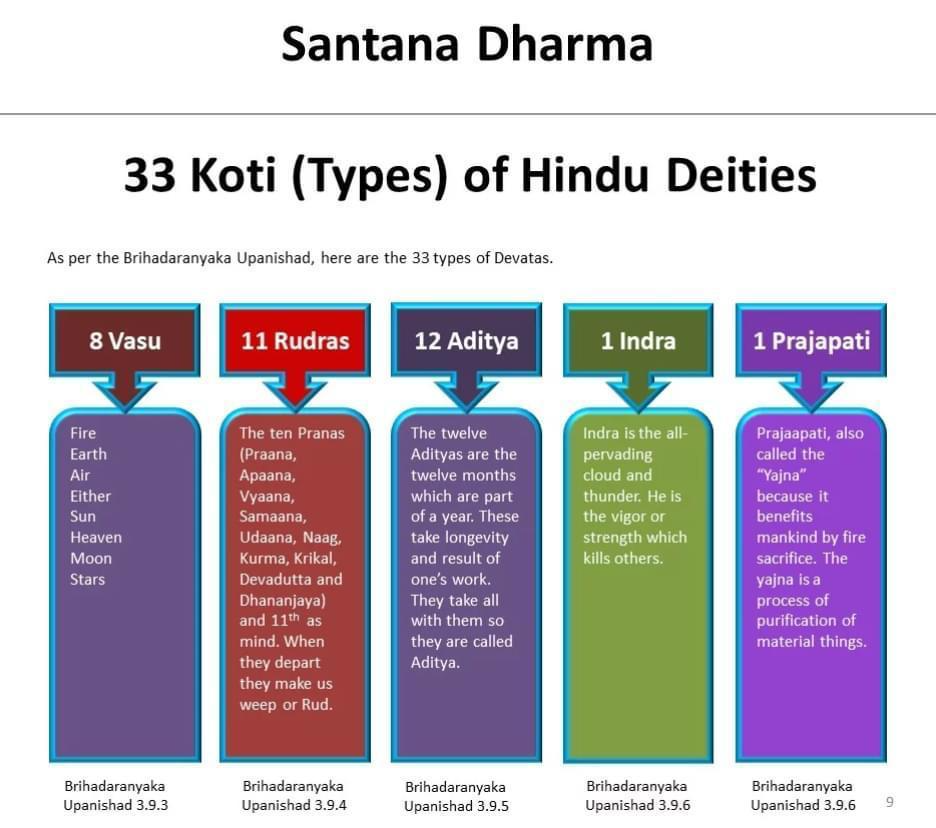
Hindus believe in only One God or the Ultimate. Here, first it has to be cleared that it is not Gods but deities (divine manifestations; devtas). Further, it is not 33 Crores (330 million) but 33 Koti (samUha, groups, types) of deities.
Blame it on the inadequacy of the English language or the vested interest of the mischievous colonial translators that created the narrative or propaganda that Hinduism is a polytheistic religion containing 33 Crore Gods. The Truth is, Hinduism is absolutely monotheistic, or more specifically believer in omnipresent one Ultimate Reality.
Per the Hindu scriptures, there are 33 categories of celestial living beings (that have finite life terms, and subject to birth- death continuum). The leaders of these 33 categories are described in Brihadaranyaka Upanishad and as shown in the diagram below. For example, the Sun is one of such deities.
Other reading material:
Relevant videos: Vandana Mishra , A Guru explaining why Hinduism is said to have 330 million gods!
Contributor: Dilip Amin
Location of this post (2i): https://www.hinduspeakers.org/ufaqs/do-hindus-have-33-crores-gods/
Category:
02. God Forms