Simple answers to your questions on Hinduism are provided here.
Use the search button (top right on desktop, top left on smartphones) to find specific topics of interest. At the bottom of each answer, check the “Tags” section for related topics. To learn more about this Q&A project, click [here].


On Hinduism
You can also download an earlier collection: 300QAs on Hinduism (PDF). Thank you.

02. God Forms
Hinduism is a religion popular for its identity of being a theology with an ocean of gods. It is believed that Hindus worship millions of gods. What is the truth behind this claim?
The word ‘God’ itself has many names in the Indian languages, the prime language being Sanskrit. Deva, Ishvara, Prabhu, Bhagwan, Sura, Parmatman and many more are the synonyms used to denote the almighty divine power.
To get an idea about the number of gods, first we need to acquaint yourself with the fact that most religions of the world are classified into one of the three theories of religion depending on the numbers of gods they believe in; namely monotheism, polytheism and henotheism.
A religion that believes in one god is monotheistic, many gods is polytheistic and a religion that believes in the existence of many gods but it’s members may choose to worship one or two gods of their choice are known as henotheistic religions. Hinduism is one very unique religion which belongs to all of the categories that represent the three theories in religion. Hinduism is monotheistic is one sense, polytheistic in another and henotheistic in a very general way.
A core concept in one of the most ancient Hindu texts, Upanishads, is the concept of one ultimate underlying supreme cosmic reality residing in the universe known as “Brahman”. Brahman is the one and only indivisible eternal divine spiritual substance in the universe. If a Hindu believes ‘only’ in this highest spiritual substance ‘Brahman’ which is genderless, than he is monotheistic. This concept of god is that of an impersonal god, who has no form or physical quality.
The Brahman represents itself in millions of different ways; each representation of Brahman is named as a god which could be either feminine or masucline. These are energies that oversee every aspect of the functioning of the universe. When one experiences god in these forms, one thinks his faith in Hinduism is polytheistic. These gods could be elements from nature like the sun, moon, wind, fire, rivers, mountains, trees or they could be personal gods that existed in some time in a form of an animal or a human or a semi human. These gods do have a physical form, a name, a quality ascribed to them. Each of these gods represent some special power or symbolize a certain character trait very typical to them.
Lastly when someone chooses to worship one of the many divine forms of the Brahman, one participates in the Hindu religion in the henotheistic sense. Hindu henotheism is an attitude of worshipping one god without denying the existence of other gods. That one god could be any element from the nature of a physical god.
The number thirty three has a significance in the Hindu scriptures. The Rig Veda, a very ancient hindu text, talks about eleven gods belonging to the realm of heaven, eleven belonging to earth and eleven to the waters. Again these are the most distinctively known gods but there are more than thirty three.
Here we have seen there is not a hierarchy of gods in Hinduism but there is a hierarchy of belief systems. No one god is higher than the others, all gods enjoy equal status in the Hindu culture. Hinduism is a kaleidoscope of beliefs and the number of gods you believe in defines your lens of looking at the divinity.
Other reading material:
Relevant videos: Swami Nikhil Anand Hinduism Q & A: How Many Gods Are There,
Contributor: Mona Rawal
Location of this post (2c): https://www.hinduspeakers.org/ufaqs/how-many-gods-hindus-have/
Category:
02. God Forms
Hindus believe in one Supreme God who created the universe. It is an all-pervasive divine reality, formless (Brahman, nirgun), or manifested in different forms (Ishvara, God/Goddess or Deities; sagun). Contrary to prevailing misconceptions, Hindus worship One Supreme Being, though by different names.
The Sanskrit hymn, Rig Veda I.164.46:
Ekam sat vipraha bahudha vadanti
Truth is one, the wise call it by many names.
The government may be contacted through the postal service, the police, the judiciary and the office of the President. We can distinguish between different aspects of the functioning of the government, while still agreeing that there is only ONE government. Hindus believe that the ONE divinity can be experienced in myriad ways. Even for one form of divinity, say Vishnu (the all-pervading one), Hindus routinely memorize 1,000 names for an essentially nameless and formless divinity. There is one Truth, and the wise know to call it by many names.
.Other reading material: HAF: Short answers to real questions about Hinduism
Hinduism Today: Why does Hinduism have so many Gods?
Relevant videos: Swami Nikhil Anand Hinduism Q & A: How Many Gods Are There
Contributor: Dilip Amin
Location of this post (2f): https://www.hinduspeakers.org/ufaqs/why-does-hinduism-have-many-gods/
Category:
02. God Forms
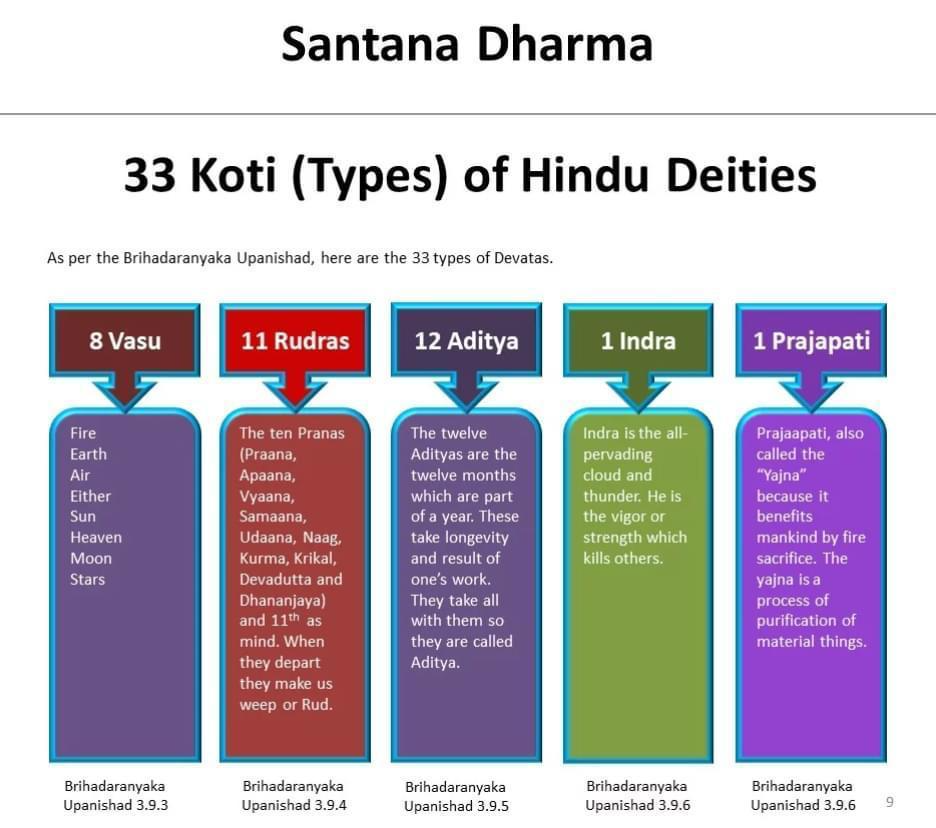
Hindus believe in only One God or the Ultimate. Here, first it has to be cleared that it is not Gods but deities (divine manifestations; devtas). Further, it is not 33 Crores (330 million) but 33 Koti (samUha, groups, types) of deities.
Blame it on the inadequacy of the English language or the vested interest of the mischievous colonial translators that created the narrative or propaganda that Hinduism is a polytheistic religion containing 33 Crore Gods. The Truth is, Hinduism is absolutely monotheistic, or more specifically believer in omnipresent one Ultimate Reality.
Per the Hindu scriptures, there are 33 categories of celestial living beings (that have finite life terms, and subject to birth- death continuum). The leaders of these 33 categories are described in Brihadaranyaka Upanishad and as shown in the diagram below. For example, the Sun is one of such deities.
Other reading material:
Relevant videos: Vandana Mishra , A Guru explaining why Hinduism is said to have 330 million gods!
Contributor: Dilip Amin
Location of this post (2i): https://www.hinduspeakers.org/ufaqs/do-hindus-have-33-crores-gods/
Category:
02. God Forms
03. General
The most common misconception is that Hinduism is a religion of “many gods.” People often picture exotic images—a Goddess riding a tiger with weapons in hand—and conclude that Hindus are polytheists.
In truth, Hindus believe in one Supreme Reality. The Rig Veda declares: Ekam Sat, Viprā Bahudhā Vadanti—“Truth is One, the wise call it by many names.”
Hindus have the freedom to experience and worship this One Divine in many forms. The various Devis and Devatas are not separate Gods, but manifestations of the same God. Think of it this way: if God is the sun, the deities are like sunrays—expressions of the same source.
Another analogy is a government:
- Goddess Lakshmi represents prosperity, like the “finance department.”
- Goddess Saraswati represents knowledge, like the “education department.”
- Lord Ganesh is invoked to remove obstacles.
- Lord Krishna guides on how to live a righteous life.
For some Hindus, the connection to divinity comes not through worship at all, but through meditation—without idols (correct word is murtis), rituals, or even temples. Hinduism even makes room for agnostics and atheists, recognizing diverse spiritual journeys.
So while Hindus believe in one God, they also have the liberty to express and connect with the Divine in multiple ways.
Other common misconceptions include:
- Idol worship – Misunderstood as worship of “objects,” when in reality murtis are symbolic focal points for connecting with the Divine. (read more)
- Caste system – Often confused with Hinduism itself, though discrimination contradicts the core Hindu principle that divinity exists in everyone (sarva bhuta antaratma).(read this and references in it)
- Violence in the Gita – Lord Krishna urging Arjuna to fight is not a call to violence, but a teaching on dharma (duty), righteousness, and moral responsibility.
Contributor: Dilip Amin
Location of this post (3i): https://www.hinduspeakers.org/ufaqs/what-is-the-main-misconception-about-hinduism/
Category:
03. General
29. Other Faiths
Yes and no. Some religions consider their God as being the “only” one. Anything else is false. Some reflect the flexibility of modern times and indicate that while others may choose to label it different, it is essentially the same “God”. So, it appears that the God-ful religions in their very own essence talk about their “different” and very “own” God. Hinduism, on the other hand, is a “God” less philosophy. There is all-pervasive energy and its creation.
Other reading material:
Relevant videos: Swami Nikhilanand Hinduism Q & A: Do Different Religions Have Different Gods
Contributor: Rajeev Singh
Location of this post (29a): https://www.hinduspeakers.org/ufaqs/do-different-religions-have-different-gods/
Category:
29. Other Faiths