Simple answers to your questions on Hinduism are provided here.
Use the search button (top right on desktop, top left on smartphones) to find specific topics of interest. At the bottom of each answer, check the “Tags” section for related topics. To learn more about this Q&A project, click [here].


On Hinduism
You can also download an earlier collection: 300QAs on Hinduism (PDF). Thank you.
13. Heaven and Hell
Sin is called Paap in Hinduism. Paap is an action to satisfy one’s senses and mind, and is therefore forbidden. Paap (sin) can be committed by mind, speech or body.
Thinking ill of others, pride and jealousy are sins committed by mind. Talking ill about others, speaking untruth, gossiping, blaming and finger pointing others are sins committed by speech. Killing living beings for mere sensual enjoyment, drinking alcohol, robbery, hitting people, eating condemned food, or any kind of violence to human beings, animals or living beings is sin committed by the body.
.
Other reading material:
Relevant videos: Swami Nikhil Anand Hinduism Q & A: What is Sin, Hinduism Q & A: Hell in Hinduism, is it the same as in Christianity?
Contributor: Geetha Ravula
Location of this post (13a): https://www.hinduspeakers.org/ufaqs/what-is-sin/
Category:
13. Heaven and Hell
16. Soul/Atman
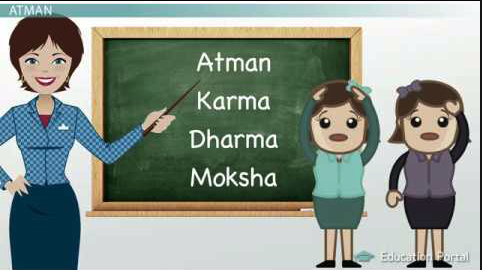
Ātman (Ātmā) is not exactly the same as what is commonly called the “soul.”
- In Christian thought, the soul is the incorporeal essence of a human being. At death, God determines the soul’s eternal fate—reward or punishment. The idea that “soul = God” is considered blasphemous in most Abrahamic traditions. Furthermore, only humans are said to have souls.
- In Hindu thought, Ātman is the divine Self—eternal, unchanging, and identical with Brahman (the Ultimate Reality). The Divine manifests in all living beings as Ātman, not only in humans but also in animals and all forms of life.
The Bhagavad Gita (2:22 or 2:20) explains that the Ātman moves from one body to another, discarding the old and taking on the new, just as we change clothes. The body is temporary, while the Ātman is permanent and in command.
Unlike the Christian soul, which can be corrupted by sin or the devil, the Ātman in Hinduism is never tainted. It remains pure and divine, beyond birth and death.
Other reading material: Rajiv Malhotra, Academic Hinduphobia, 2016 (p. 49)
Relevant videos:
Contributor: Dilip Amin
Location of this post (16f): https://www.hinduspeakers.org/ufaqs/is-atman-the-same-as-soul/
Category:
16. Soul/Atman