Simple answers to your questions on Hinduism are provided here.
Use the search button (top right on desktop, top left on smartphones) to find specific topics of interest. At the bottom of each answer, check the “Tags” section for related topics. To learn more about this Q&A project, click [here].

On Hinduism
You can also download an earlier collection: 300QAs on Hinduism (PDF). Thank you.
01. God Concept
Hindus believe that there exists a changeless, all powerful intelligent being called the Brahman (aka God or Bhagavan), which pervades through the entire cosmos. An individual is not just the body and mind. Brahman and Atman exist within each human being. Hindus believe it is possible for the Atman in each individual to reach the Brahman at a higher state of intelligence usually achieved through karma yoga or Bhakti yoga.
Who am I?
I am the Atma (aka Jeevatma), which is different from this body, senses, mind, breath, and its cognitive abilities. The relationship between the Atma and the Body is that of Owner/Owned. When the owner (Atma) leaves the Owned (Body) it is called death. When the Owner acquires a new body it is called birth. Atma is eternal and keeps on journeying from one body to another until liberation.
How am I related to God?
God in His Antaryami (Antaratma) form, pervades everything in this universe and beyond. He pervades this lifeless body as well the life (Atma) within it. The relationship between the Antaratma and Atma is one of Owner/Owned. That is, Antaratma is the Owner and Atma is the owned.
Overall relationship:
God owns the Atma and directs it’s decision making.
Atma owns the body, makes decisions and directs its actions.
While Atma may move from body to body, God never disowns the Atma.
Sources used: Hindu Community Institute Course materials on Counselor of Hindu Traditions; Book: Many Many Gods of Hinduism by Swami Achuthananda. Meaning of AUM per Sri Pancharatra Agama.
Other reading material:
Relevant videos
Contributor: Seema Garg Murthy and Sudershan
Location of this post (1m): https://www.hinduspeakers.org/ufaqs/who-am-i-how-am-i-related-to-god/
Category:
01. God Concept
05. Traditions
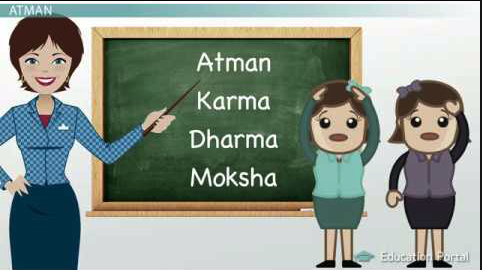
The basic tenets of Hinduism that all Hindus believe in are the concepts of:
- Dharma: Dharma is laws and order by which this universe is sustained. Dharma is the mode of conduct for an individual that is most conducive to spiritual advancement.
- Karma: We are responsible for our actions. Sometimes, we might not understand the events of life, but they are the sum total of our karma over multiple lifetimes. However, our past karma only decides some situations in life (prarabdha), we still have control over our karma in this lifetime, and all our life in this lifetime is not predestined.
- Atman/Soul: meaning that there is a light within each living being and that we are beyond our physical bodies. The Atman cannot be killed or destroyed, only the physical body can be destroyed.
- Kaal chakra (Samsara, Wheel of life): meaning that there is a continuous cycle of birth, death and rebirth.
- Moksha: That it is possible for human beings to realize their true nature and be one with their soul while in their physical body. Once the self realization happens, then one is said to attain moksha, and become free from the cycle of birth and death.
Other reading material:
Relevant videos:
Contributor: Swati Sugandhi
URL link of this page (5b): https://www.hinduspeakers.org/ufaqs/what-are-basic-tenets-of-hinduism/
Category:
05. Traditions
14. Afterlife
Death is inevitable and deterministic (uncontrollable) according to the Hindu religion.
Death does not imply the cessation of our existence, but it means a new beginning. Death is just a small milestone on the journey of infinite miles of eternal existence. Thus the phenomena of death is linked to the concept of rebirth.
Hinduism has a deep rooted belief in the theory of rebirth; the idea of rebirth is connected to the idea of the ‘Atman’ or the Soul, the individual’s non-material inner self that is eternal. The Atman cannot be experienced with the five sense organs but it does exist as a spiritual substance. When a human dies, the Atman from his body detaches itself from the literal body and moves out in search of another body and there occurs rebirth.
How does the Atman decide what it wants to be reborn again as? This question takes us to one of the most basic philosophical theories of Hinduism; the concept of Karma. Karma is the accumulated past actions waiting to come to fruition. One’s rebirth depends on past actions (Karma), good deeds taking you towards better births and immoral deeds taking you towards birth in lower category creatures like animals.
Thus Hinduism gives a highly positive interpretation to the concept of death and the journey beyond this life. We will always live in the form of an Atman and death is a milestone on the journey of the Atman.
In Bhagavad Gita, Supreme GOD Sree Krishna says to Arjun (Chapter 2, Sloka 22):
vāsānsi jīrṇāni yathā vihāya
navāni gṛihṇāti naro ’parāṇi
tathā śharīrāṇi vihāya jīrṇānya
nyāni sanyāti navāni dehī
As a person sheds worn-out garments and wears new ones, likewise, at the time of death, the soul casts off its worn-out body and enters a new one.
Other reading material:
Relevant videos: Swami Nikhil Anand What happens when we die?, What is Reincarnation?,
Contributor: Mona Raval
Location of this post (14b): https://www.hinduspeakers.org/ufaqs/what-happens-when-we-die/
Category:
14. Afterlife
15. Reincarnation
Hindus believe that the Atman (soul) is immortal passing through the process wherein the Atman reincarnates into different physical bodies through cycles of birth and death. Guided by the Laws of Karma, the Atman continues on its path of spiritual evolution. The ultimate aim of Hindus is for the Atman to attain freedom from this continuous cycle of birth and rebirth and discover its divine origin.
Imagine a single tennis game where the person who has the serve, also has been given an ability to serve an Ace 100% of the time. What are the rules for success where the coin toss can determine game outcomes? Would you believe there is any merit in learning to play the game well? What if you just play one game, a single event? Would you think the game is fair?
If you answer is NO, then you have just made an argument in favor of reincarnation. You just have to conclude that for the world to be non-random, there have to be multiple games played, and the success in one game improves the beginning odds in the next game.
If you disagree, then you have just concluded that all life is random, and there is very little advantage in learning to live better.
Despite the dogma against it in the western world, there are still scientific studies done on remembering past lives. The Medical School at University of Virginia maintains a site and has written several scientific papers journaling reported pre-birth experiences that are very analogous to the detailed descriptions in the Hindu Tradition. Just read with an open mind.
.
Other reading material: HAF: Do Hindus believe in reincarnation? Division of Perceptual Studies | University of Virginia School
Back When I Was Older : Invisibilia , Reincarnation: WHO is it that Travels? Atma? Jiva? Subtle body?
Relevant videos: Swami Nikhilanand What is Reincarnation?, What happens when we die?, Can I be born as a plant or animal? Swami Tadatmananda on reincarnation: Reincarnation: WHO is it that Travels? Atma? Jiva? Subtle body?
Contribution: Gaurav Rastogi
Location of this post (15b): https://www.hinduspeakers.org/ufaqs/do-hindus-believe-in-reincarnation/
Category:
15. Reincarnation
Hinduism does not teach ideas such as eternal Heaven or Hell. It sees life as a process of evolution where we grow spiritually over many lives.
Behavior in a past life, combined with dharma (the duty you are born with) for this life, creates the lives we live in the present.
With each incarnation we get new lessons, based on what lessons we passed and failed in the last life. If you were an abusive person in a past life, your karma dictates you will be on the receiving end of abuse in this or future lives. Forgiving your abuser where appropriate, and asking for forgiveness for yourself, frees you from the karma.
When an Atman persists in not learning lessons, abusing, not forgiving; a vicious cycle of birth and death is created until the Atman evolves and attains moksha (liberation from the cycle of birth and death).
Other reading material: The Momentum of Karma
Relevant videos: Swami Nikhil Anand Hinduism Q & A: What is Good Action, Why I become Hindu, Transcending Karma, The Deeper Meaning of Dharma,
Contributor: Swamini VishwaPratibha
Location of this page (15c): https://www.hinduspeakers.org/ufaqs/c-how-much-has-ones-past-life-had-an-impact-on-the-current-life/
Category:
15. Reincarnation
Hindus consider all living beings to have an Atman (soul). The atman reincarnates, and subsequent births are determined by past karma. Karma rooted in higher consciousness leads to births in species of higher consciousness (humans). Karma of lower consciousness birth the atman in species of lower consciousness. Yes, you can be an ant in the next life.
There is a story of Jada Bharatan from Sriman Bhagavatam. Bharat was a king who performed many pious rituals for the betterment of his people and kingdom. In old age, wanting to retire, he chose a lonely place around a pond. There he stayed several years, doing penance for his Moksha. He found a fawn that had been attacked by a tiger and hurt badly. He rescued it and started caring for it. He grew an attachment for it, looking for its welfare. At the time of his death, he was very worried for this fawn. Therefore he was born as a fawn in his left life.
Inference : This is the concept of “Antima Smriti” – what you think of at the time of death is what you are born as in the next life. In this story, it is clear that human beings, even the most pious, can be born in a lower life form.
Other reading material:
Relevant videos:
Contributor: Team
Location of this page (15d): hinduspeakers.org/ufaqs/can-i-be-an-ant-in-the-next-life/
Category:
15. Reincarnation
Do you remember what you had for breakfast a week ago? We don’t carry all memories even to the next day, so how will we carry all memories from this lifetime to the next, or from the past to this life? However, there are some examples of a few people who remembered something from their past life.
Actually, not remembering your past life is a blessing, is it not? Won’t we be totally miserable if we remembered all of our past 1000 lives?
We do carry some subtle memories even after we leave our physical body. For example, we have inherent liking and disliking for certain things. One might inherently like mountains and another person might find more solace at a beach. We also have inherent personalities. One sibling is an extrovert and the other an introvert–how do you explain that?
Other reading material:
Relevant videos: Swami Nikhil Anand Hinduism Q&A: Why Don’t We Remember Our Past Lives? , HG Chanchalapathi Dasa, Iskon
Contributor: Swati Sudandhi
Location of this post (15e): https://www.hinduspeakers.org/ufaqs/why-dont-we-remember-our-past-life/
Category:
15. Reincarnation
16. Soul/Atman
First, Soul is not Atman.
Think of Atma (or Soul as in this question) as the life energy within you that moves from one body to another body in the cycle of life and death that we call Samsara. This life energy is a part of the infinite, unbounded energy that prevails the entire cosmos (Parmatama). When one talks about life energy, it is unbounded and not in terms of numbers.
People ask when more births are happening than death, does that mean souls are coming from other life forms (animals, plans, etc.) and the total aggregate number of souls is constant on Earth?
Please know that numbers are only for the physical world, the life force (atma) knows no such physical limit and its arithmetic as the fundamental life force is unbounded and permeates the entire existence.
I have one lit candle. Five people come by and light their candles from my one light. Where have the new flames come from? The rules of physical mathematics do not apply to the spiritual realm.
Can we reach infinite by counting 1, 2, 3 to 100, to 1000, to millions and so on? We will keep counting endlessly but will never reach the Infinite. So the question of the finite number of souls on earth would not be a valid one as soul is an infinitesimal part of this unbounded infinite energy and we can not count in terms of numbers.
Source: Sadhguru Satsang
Other reading material:
Relevant videos: Swami Nikhil Anand Is the soul of an ant bigger than the soul of a whale?,
Contributor: Vikas Gupta
Location of this post (16a): https://www.hinduspeakers.org/ufaqs/if-a-soul-goes-to-a-new-body-where-does-a-new-soul-come-for-increased-world-population/
Category:
16. Soul/Atman
According to Hindu scriptures, there is no death for the Atman (soul is a wrong term). The human Atman (jīvātma) is considered to be of the same essence as the Divine Supreme Atman (paramātma), also termed as Consciousness. Hence the Atman, in the Hindu context, is eternal, imperishable, changeless, and that which illumines everything.
The Atman can be thought of as a source of light. While the furniture in a room might keep changing, the reason one can see and experience these items is due to the presence of the light. Similarly, we are able to perceive, feel and think in the world because of our soul.
Lord Krishna declares in the Bhagavad Gita, Chapter 2, Verse 20:
na jāyate mriyate vā kadāchin nāyaṁ bhūtvā bhavitā vā na bhūyaḥ
ajo nityaḥ śhāśhvato ’yaṁ purāṇo na hanyate hanyamāne śharīre
The Atman is neither born, nor does it ever die; nor having once existed, does it ever cease to be. It is without birth, eternal, immortal, and ageless. The Atman is not destroyed when the body is destroyed.
Thus, Hindu theologians conclude that the Atman does not die. When a person passes on, their body decays, mind stops thinking, but the Atman, however, continues to exist. It leaves the body and moves onto a different realm of experience, based on what that particular Atman needs for evolution. This is valid for all living beings, and not just humans. It is due to this belief system that Hindus propound the theory of karma and reincarnation. The Atman evolves by taking on different births, until it reaches spiritual maturity and finally merges with the Divine Consciousness. This, liberation (moksha), is the goal of life on earth.
Other reading material: Reincarnation: WHO is it that Travels? Atma? Jiva? Subtle body?
Relevant videos: Swami Nikhil Anand Hinduism Q & A: What happens when we die?, Hinduism Q & A: Can the soul die?, Hinduism Q & A: What is Reincarnation?,
Contributor: Lakshmi Subramanian
Location of this post (16b): https://www.hinduspeakers.org/ufaqs/can-the-soul-die/
Category:
16. Soul/Atman
Just as the combination of many strong and weak, visible and invisible forms of energy gives rise to waves in an ocean, the Brahman/Atma (energy, soul is not a right terminology) gives life to entities around us and including us. Why were the waves created? We don’t know. Why were Atman created? We don’t know. It just is.
GOD didn’t create Atmans. Atmans existed in the past, exist in the present and will exist in the future
na jāyate mriyate vā kadāchin
nāyaṁ bhūtvā bhavitā vā na bhūyaḥ
ajo nityaḥ śhāśhvato ’yaṁ purāṇo
na hanyate hanyamāne śharīre
The Atman is neither born, nor does it ever die; nor having once existed, does it ever cease to be. The Atman is without birth, eternal, immortal, and ageless. It is not destroyed when the body is destroyed.
Other reading material:
Relevant videos: Swami Nikhil Anand Hinduism Q & A: Why did God create souls?
Contributor: Rajeev Singh
Location of this post (16c): https://www.hinduspeakers.org/ufaqs/why-did-god-create-souls/
Category:
16. Soul/Atman
Not every soul (Atman is the correct terminology) that is manifested is incarnate in human form at any given time. Aside from the Atmans that are now embodied in the plant and animal kingdom, there are other spheres of existence where Atmans reside. And Atmans are consistently emanating from Divinity. The Hindu scriptures do not place an exact number of Atmans, either in the created universe or beyond.
.
Other reading material: Reincarnation: WHO is it that Travels? Atma? Jiva? Subtle body?
Relevant videos: Swami Nikhil Anand Hinduism Q & A: How many souls are there?,
Contributor: Fred Stella
Location of this post (16d): https://www.hinduspeakers.org/ufaqs/how-many-souls-are-there/
Category:
16. Soul/Atman
Ātman (Ātmā) is not exactly the same as what is commonly called the “soul.”
- In Christian thought, the soul is the incorporeal essence of a human being. At death, God determines the soul’s eternal fate—reward or punishment. The idea that “soul = God” is considered blasphemous in most Abrahamic traditions. Furthermore, only humans are said to have souls.
- In Hindu thought, Ātman is the divine Self—eternal, unchanging, and identical with Brahman (the Ultimate Reality). The Divine manifests in all living beings as Ātman, not only in humans but also in animals and all forms of life.
The Bhagavad Gita (2:22 or 2:20) explains that the Ātman moves from one body to another, discarding the old and taking on the new, just as we change clothes. The body is temporary, while the Ātman is permanent and in command.
Unlike the Christian soul, which can be corrupted by sin or the devil, the Ātman in Hinduism is never tainted. It remains pure and divine, beyond birth and death.
Other reading material: Rajiv Malhotra, Academic Hinduphobia, 2016 (p. 49)
Relevant videos:
Contributor: Dilip Amin
Location of this post (16f): https://www.hinduspeakers.org/ufaqs/is-atman-the-same-as-soul/
Category:
16. Soul/Atman
23. Yoga and Meditation
OM, ॐ or AUM (pranava) refers to Atman (soul, self within) and Brahman (ultimate reality, truth, divine, supreme spirit, cosmic principles).
OM is a mantra. Its meaning slightly differs depending on how it is used. First of all OM is a sound symbol for God or Divinity. Just like cross is a physical symbol for Christ, OM is also a symbol, but it is in a sound form. OM is used as a sound during meditation practice. You chant OM and listen to it. Here it is used just as a soothing sound. OM also means “Everything together” as in Infinity.
OM is made up of 3 letters followed by silence; (In Sanskrit; breathing pattern is explained) A (expel air from stomach area) + U (expel air from the chest region) + M (think like you are expelling air from your mind and mouth) + silence (a brief breathless period). AUM stands for beginning, middle and end + silence.
Other reading material: Yoga Sutra 1.27 , What is AUṀ? , The Significance of ॐ: A Linguistic and Philosophical Analysis
Relevant videos:
Contributor: Dr. Jyoti Lulla
Location of this post (23a): https://www.hinduspeakers.org/ufaqs/om-what-does-it-mean/
Category:
23. Yoga and Meditation