Simple answers to your questions on Hinduism are provided here.
Use the search button (top right on desktop, top left on smartphones) to find specific topics of interest. At the bottom of each answer, check the “Tags” section for related topics. To learn more about this Q&A project, click [here].


On Hinduism
You can also download an earlier collection: 300QAs on Hinduism (PDF). Thank you.
The Hindu wedding, called Vivaha, is the most important samskara (sacrament, rite of passage) of Hindu life. Hindu weddings are colorful and elaborate extending to several days. Prior to the wedding day, there are mehdi (hand painting), a music festival, Garba dance programs, and more.
On the wedding day, the groom and family arrive at the bride’s home. The groom is considered to be an incarnation of Lord Vishnu. The bride, considered to be an incarnation of Goddess Lakshmi, arrives at the venue with her maternal uncle. At the beginning of any Hindu religious ceremony, Lord Ganesha’s blessings are sought as He is the remover of all obstacles. The groom adorns the bride’s neck with a necklace called mangala-sūtra i.e. auspicious thread. The ends of the sari worn by the bride and the shawl worn by the groom are formally tied. It has the symbolic meaning of tying two lives together. There is a homa (offerings to Agni) where the couple is seeking Agni’s blessing. Then there is Saptapadih, the seven-step circumambulations around Agni (fire), which is recognized as the essence of a Hindu wedding. These are Saptapadih oaths:
1. Be a provider of food in abundance
2. Bring vigor and energy to the household
3. Be a harbinger of prosperity to the family
4. Always bring comfort to the household
5. Have many children together with the husband
6. Enjoy with him all that the seasons have to offer
7. Become his true and unwavering friend for life.
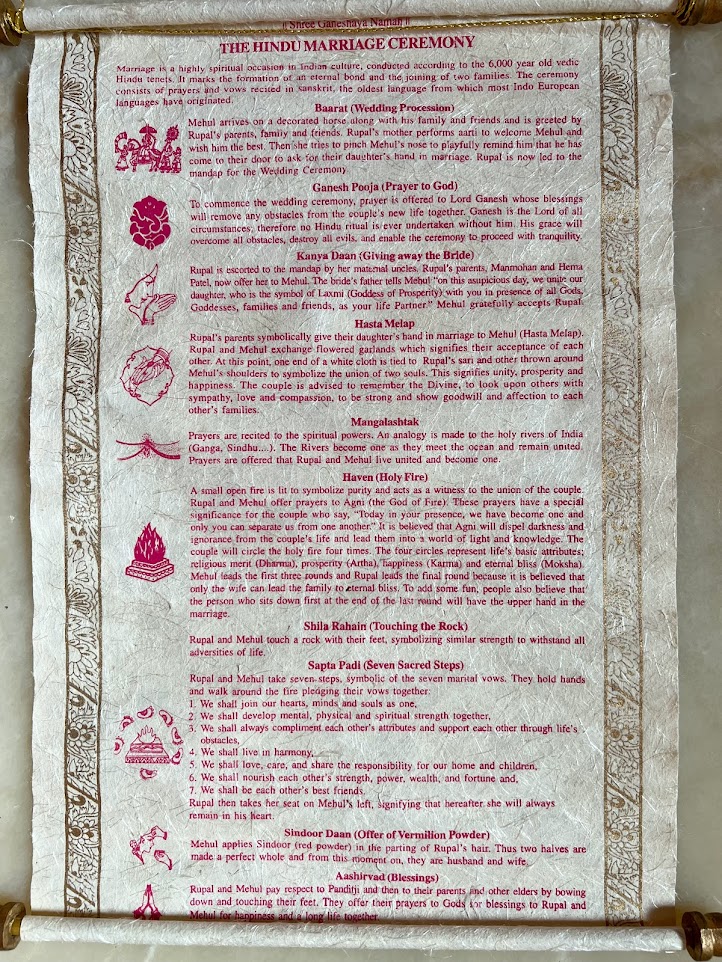
Source: The book Vivāha Saṃ̣skāra: The Hindu Wedding Ceremony.
Other reading material:
Relevant videos:Hindu wedding, Fusion Hindu wedding,
Location of this post (26c): hinduspeakers.org/ufaqs/what-is-a-hindu-wedding-like/
Category:
26. Marriages