Simple answers to your questions on Hinduism are provided here.
Use the search button (top right on desktop, top left on smartphones) to find specific topics of interest. At the bottom of each answer, check the “Tags” section for related topics. To learn more about this Q&A project, click [here].


On Hinduism
You can also download an earlier collection: 300QAs on Hinduism (PDF). Thank you.
14. Afterlife
Death is inevitable and deterministic (uncontrollable) according to the Hindu religion.
Death does not imply the cessation of our existence, but it means a new beginning. Death is just a small milestone on the journey of infinite miles of eternal existence. Thus the phenomena of death is linked to the concept of rebirth.
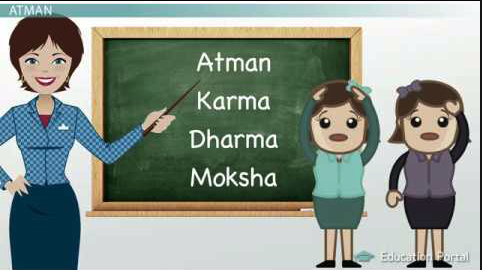
Hinduism has a deep rooted belief in the theory of rebirth; the idea of rebirth is connected to the idea of the ‘Atman’ or the Soul, the individual’s non-material inner self that is eternal. The Atman cannot be experienced with the five sense organs but it does exist as a spiritual substance. When a human dies, the Atman from his body detaches itself from the literal body and moves out in search of another body and there occurs rebirth.
How does the Atman decide what it wants to be reborn again as? This question takes us to one of the most basic philosophical theories of Hinduism; the concept of Karma. Karma is the accumulated past actions waiting to come to fruition. One’s rebirth depends on past actions (Karma), good deeds taking you towards better births and immoral deeds taking you towards birth in lower category creatures like animals.
Thus Hinduism gives a highly positive interpretation to the concept of death and the journey beyond this life. We will always live in the form of an Atman and death is a milestone on the journey of the Atman.
In Bhagavad Gita, Supreme GOD Sree Krishna says to Arjun (Chapter 2, Sloka 22):
vāsānsi jīrṇāni yathā vihāya
navāni gṛihṇāti naro ’parāṇi
tathā śharīrāṇi vihāya jīrṇānya
nyāni sanyāti navāni dehī
As a person sheds worn-out garments and wears new ones, likewise, at the time of death, the soul casts off its worn-out body and enters a new one.
Other reading material:
Relevant videos: Swami Nikhil Anand What happens when we die?, What is Reincarnation?,
Contributor: Mona Raval
Location of this post (14b): https://www.hinduspeakers.org/ufaqs/what-happens-when-we-die/
Category:
14. Afterlife
16. Soul/Atman
Just as the combination of many strong and weak, visible and invisible forms of energy gives rise to waves in an ocean, the Brahman/Atma (energy, soul is not a right terminology) gives life to entities around us and including us. Why were the waves created? We don’t know. Why were Atman created? We don’t know. It just is.
GOD didn’t create Atmans. Atmans existed in the past, exist in the present and will exist in the future
na jāyate mriyate vā kadāchin
nāyaṁ bhūtvā bhavitā vā na bhūyaḥ
ajo nityaḥ śhāśhvato ’yaṁ purāṇo
na hanyate hanyamāne śharīre
The Atman is neither born, nor does it ever die; nor having once existed, does it ever cease to be. The Atman is without birth, eternal, immortal, and ageless. It is not destroyed when the body is destroyed.
Other reading material:
Relevant videos: Swami Nikhil Anand Hinduism Q & A: Why did God create souls?
Contributor: Rajeev Singh
Location of this post (16c): https://www.hinduspeakers.org/ufaqs/why-did-god-create-souls/
Category:
16. Soul/Atman