Simple answers to your questions on Hinduism are provided here.
Use the search button (top right on desktop, top left on smartphones) to find specific topics of interest. At the bottom of each answer, check the “Tags” section for related topics. To learn more about this Q&A project, click [here].

On Hinduism
You can also download an earlier collection: 300QAs on Hinduism (PDF). Thank you.
14. Afterlife
Rest in Peace (RIP) is an Abrahamic concept, as per which the body waits or rests in a grave. On Judgement Day, the body gets united with the soul and rises again. God will make judgement for who will go to heaven or eternal hell.
Hindus believe in reincarnation of the departed soul to a new body and soul does not rest. Hindus have a concept that if the soul is trapped inside the earth, then it’s called as a Preta (a disturbed soul and in suffering). Suffering in Hell is better as it’s temporary, but not getting trapped here. Thus to tell RIP is a disrespect to the departed Hindu.
“Param Gati Mile” (may the soul attain moksha), “Om Sadagati” and “Om Shanti” are appropriate expressions when a Hindu passes away.
Other reading material: Here is why saying ‘Rest in Peace’ is a disservice to the departed Hindu soul,
Relevant videos:
Contributor: Dilip Amin
Location of this post (14a): https://www.hinduspeakers.org/ufaqs/is-rip-an-appropriate-expression-for-a-departed-hindu/
Category:
14. Afterlife
Death is inevitable and deterministic (uncontrollable) according to the Hindu religion.
Death does not imply the cessation of our existence, but it means a new beginning. Death is just a small milestone on the journey of infinite miles of eternal existence. Thus the phenomena of death is linked to the concept of rebirth.
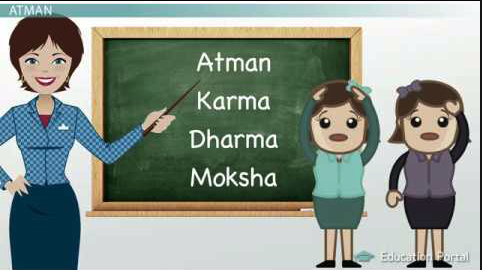
Hinduism has a deep rooted belief in the theory of rebirth; the idea of rebirth is connected to the idea of the ‘Atman’ or the Soul, the individual’s non-material inner self that is eternal. The Atman cannot be experienced with the five sense organs but it does exist as a spiritual substance. When a human dies, the Atman from his body detaches itself from the literal body and moves out in search of another body and there occurs rebirth.
How does the Atman decide what it wants to be reborn again as? This question takes us to one of the most basic philosophical theories of Hinduism; the concept of Karma. Karma is the accumulated past actions waiting to come to fruition. One’s rebirth depends on past actions (Karma), good deeds taking you towards better births and immoral deeds taking you towards birth in lower category creatures like animals.
Thus Hinduism gives a highly positive interpretation to the concept of death and the journey beyond this life. We will always live in the form of an Atman and death is a milestone on the journey of the Atman.
In Bhagavad Gita, Supreme GOD Sree Krishna says to Arjun (Chapter 2, Sloka 22):
vāsānsi jīrṇāni yathā vihāya
navāni gṛihṇāti naro ’parāṇi
tathā śharīrāṇi vihāya jīrṇānya
nyāni sanyāti navāni dehī
As a person sheds worn-out garments and wears new ones, likewise, at the time of death, the soul casts off its worn-out body and enters a new one.
Other reading material:
Relevant videos: Swami Nikhil Anand What happens when we die?, What is Reincarnation?,
Contributor: Mona Raval
Location of this post (14b): https://www.hinduspeakers.org/ufaqs/what-happens-when-we-die/
Category:
14. Afterlife
15. Reincarnation
Hindus believe that the Atman (soul) is immortal passing through the process wherein the Atman reincarnates into different physical bodies through cycles of birth and death. Guided by the Laws of Karma, the Atman continues on its path of spiritual evolution. The ultimate aim of Hindus is for the Atman to attain freedom from this continuous cycle of birth and rebirth and discover its divine origin.
Imagine a single tennis game where the person who has the serve, also has been given an ability to serve an Ace 100% of the time. What are the rules for success where the coin toss can determine game outcomes? Would you believe there is any merit in learning to play the game well? What if you just play one game, a single event? Would you think the game is fair?
If you answer is NO, then you have just made an argument in favor of reincarnation. You just have to conclude that for the world to be non-random, there have to be multiple games played, and the success in one game improves the beginning odds in the next game.
If you disagree, then you have just concluded that all life is random, and there is very little advantage in learning to live better.
Despite the dogma against it in the western world, there are still scientific studies done on remembering past lives. The Medical School at University of Virginia maintains a site and has written several scientific papers journaling reported pre-birth experiences that are very analogous to the detailed descriptions in the Hindu Tradition. Just read with an open mind.
.
Other reading material: HAF: Do Hindus believe in reincarnation? Division of Perceptual Studies | University of Virginia School
Back When I Was Older : Invisibilia , Reincarnation: WHO is it that Travels? Atma? Jiva? Subtle body?
Relevant videos: Swami Nikhilanand What is Reincarnation?, What happens when we die?, Can I be born as a plant or animal? Swami Tadatmananda on reincarnation: Reincarnation: WHO is it that Travels? Atma? Jiva? Subtle body?
Contribution: Gaurav Rastogi
Location of this post (15b): https://www.hinduspeakers.org/ufaqs/do-hindus-believe-in-reincarnation/
Category:
15. Reincarnation
Hindus consider all living beings to have an Atman (soul). The atman reincarnates, and subsequent births are determined by past karma. Karma rooted in higher consciousness leads to births in species of higher consciousness (humans). Karma of lower consciousness birth the atman in species of lower consciousness. Yes, you can be an ant in the next life.
There is a story of Jada Bharatan from Sriman Bhagavatam. Bharat was a king who performed many pious rituals for the betterment of his people and kingdom. In old age, wanting to retire, he chose a lonely place around a pond. There he stayed several years, doing penance for his Moksha. He found a fawn that had been attacked by a tiger and hurt badly. He rescued it and started caring for it. He grew an attachment for it, looking for its welfare. At the time of his death, he was very worried for this fawn. Therefore he was born as a fawn in his left life.
Inference : This is the concept of “Antima Smriti” – what you think of at the time of death is what you are born as in the next life. In this story, it is clear that human beings, even the most pious, can be born in a lower life form.
Other reading material:
Relevant videos:
Contributor: Team
Location of this page (15d): hinduspeakers.org/ufaqs/can-i-be-an-ant-in-the-next-life/
Category:
15. Reincarnation