Simple answers to your questions on Hinduism are provided here.
Use the search button (top right on desktop, top left on smartphones) to find specific topics of interest. At the bottom of each answer, check the “Tags” section for related topics. To learn more about this Q&A project, click [here].


On Hinduism
You can also download an earlier collection: 300QAs on Hinduism (PDF). Thank you.
03. General
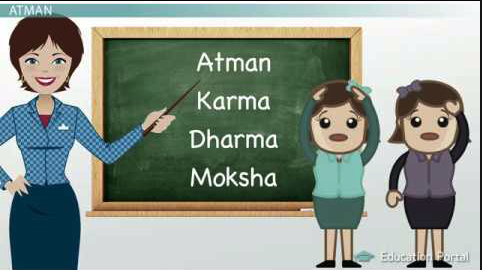
Hinduism or Sanatana Dharma (Eternal Path) is the oldest religion and it originated in the Indian subcontinent (current day India-Pakistan-Bangladesh-Afghanistan-Nepal-Bhutan). It is a sum total of various Indic philosophies and ways of life of the people in the Indian subcontinent. Even though the cultural values vary among different traditions within Hinduism, the common threads of four values binds all the traditions together:
Dharma: The law of the cosmos/true path. On an individual level, one’s personal duty.
Karma: Action (Papa and Punya)
Sansara: Cycle of life (birth-death-rebirth)
Moksha: Liberation of the soul (Atma) from Sansara (the cycle of life and death)
Other reading material:
Relevant videos:
Contributor: Swati Sugandhi
Location of this post (3f): https://www.hinduspeakers.org/ufaqs/how-is-hinduism-defined/
Category:
03. General
There are over a billion Hindus. One out of seven people on this planet is a Hindu.
1. Let’s start with Who is God? To seek God, you do not have to look outside but inside–to our soul or atman–is God. You do not realize your inner beauty because of your ego, greed, and trying to impress others. Remember, the day that inner spirit leaves you, you are worthless and only the dead body remains, at best the prettiest dead body.
2. Hindus believe in reincarnation; death is not an end but the soul moves to a new body. A tree doesn’t die but it goes back to where it came from, that is dirt, elements and water. In its place, a new tree will come.
3. On how to pray? Hindus have many ways to unite or yoga with divinity, like meditation—Raja Yoga, knowledge—Gnana Yoga, service to others—Karma Yoga and the most popular being the Bhakti Yoga which is devotional in nature.
4. Where is god? God is omnipresent. Namaste means I see divine in you and bow to you. Further, God is present in animals, plants, mother earth, sun and moon.
5. We do not have doctrines, like “thou shall not eat beef.” As an example, Hinduism teaches us to minimize violence – in practice, and even in thought. It teaches us that animals have equal rights on this earth. Therefore, if you feel justified to kill animals just for your taste buds, then it is your choice.
6. We have many scriptures. One popular scripture is the Bhagavad Gita and is the most well-known. It is a self-improvement guide. Gita teaches us how to be happy in this life and teaches us to do good karma.
Other reading material: https://www.hinduismtoday.com/magazine/july-august-september-2019/educational-insight-hinduism-in-a-nutshell/
Relevant videos:
Contributor: Dilip Amin
Location of this post (3g): https://www.hinduspeakers.org/ufaqs/what-are-the-main-teachings-of-hinduism-for-a-layman/
Category:
03. General
05. Traditions
The basic tenets of Hinduism that all Hindus believe in are the concepts of:
- Dharma: Dharma is laws and order by which this universe is sustained. Dharma is the mode of conduct for an individual that is most conducive to spiritual advancement.
- Karma: We are responsible for our actions. Sometimes, we might not understand the events of life, but they are the sum total of our karma over multiple lifetimes. However, our past karma only decides some situations in life (prarabdha), we still have control over our karma in this lifetime, and all our life in this lifetime is not predestined.
- Atman/Soul: meaning that there is a light within each living being and that we are beyond our physical bodies. The Atman cannot be killed or destroyed, only the physical body can be destroyed.
- Kaal chakra (Samsara, Wheel of life): meaning that there is a continuous cycle of birth, death and rebirth.
- Moksha: That it is possible for human beings to realize their true nature and be one with their soul while in their physical body. Once the self realization happens, then one is said to attain moksha, and become free from the cycle of birth and death.
Other reading material:
Relevant videos:
Contributor: Swati Sugandhi
URL link of this page (5b): https://www.hinduspeakers.org/ufaqs/what-are-basic-tenets-of-hinduism/
Category:
05. Traditions
06. Life Goal
Aim of Human life is known as Purushartha (endeavours), “goals of human existence” or “the Atma’s purpose.” The Hindu Human Pursuit is a progression through the four endeavors – Dhama, Kama, Artha, and Moksha.
Dharma is the right way of living, being conscious in your actions, words and thoughts and living a life that is lawful and harmonious.
Kama is desire. We cannot live without a desire or a goal in life. Desire should follow Dharma.
Artha is money. Money is an important goal in human life and should be earned according to Dharma and is best when utilized towards Moksha.
The ultimate goal for a human life is to attain Moksha, which means liberation from the cycle of birth and death.
Other reading material:
Relevant videos: Swami Nikhil Anand Hinduism Q & A: What is the aim of life?,
Contribution: Geetha Ravula
Location of this file (6a): https://www.hinduspeakers.org/ufaqs/what-is-the-goal-of-human-life/
Category:
06. Life Goal
07. Scriptures
The verse Gita 2:47 reads:
कर्मण्येवाधिकारस्ते मा फलेषु कदाचन ।
मा कर्मफलहेतुर्भूर्मा ते सङ्गोऽस्त्वकर्मणि ॥
Literal meaning: You have the right only to action, never to its results. Do not think yourself the cause of the results of action, and do not be attached to inaction.
- The first phrase, कर्मण्येवाधिकारस्ते (karmaṇy-evādhikāras te), means you are entitled to action alone. As a human being with free will, your “right” lies in doing.
- The second phrase, मा फलेषु कदाचन (mā phaleṣhu kadācana), teaches that you never have ownership of the results. Even if your action contributes to success, the outcome is shaped by many other factors—seen and unseen—beyond your control.
Key insight:
Focusing only on results makes happiness conditional and fragile. If results don’t come, disappointment follows; if they do, fear of losing them sets in. By contrast, giving full attention to meaningful action in the present brings peace, regardless of outcome.
Thus, the Gita’s teaching is not to abandon goals but to act with dedication, without clinging to results. The past belongs to intention, the future to results—but the present moment belongs to action.
Contributor: Manju Gupta
Location of this post (7f): https://www.hinduspeakers.org/ufaqs/what-does-this-mean-ma-phaleshu-kadachana-gita-247/
Category:
07. Scriptures
10. Karma
God created the Universe and gave us many resources along with spiritual knowledge. We can put our senses to enjoy materialistic pleasures of the world and use the spiritual knowledge to elevate our soul and break the cycle of life and death. Choice is ours. It’s all up to human beings how rightfully or wrongfully we use these resources.
For example, God created fire; fire can be used to cook a nice dish, can be used as a bonfire in winter or can be used to set a house on fire. Human beings’ endless selfish desire and greed to accumulate has created disparity in this world and made the world imperfect.
If only human beings share just like nature we would make it a perfect world. Just like trees, rivers, sun and forest; they all take minimal from what is available to them and give and share all what they have.
.
Other reading material:
Relevant videos: Swami Nikhil Anand Hinduism Q & A: How Could A Perfect God Create An Imperfect World
Contributor: Geetha Ravula
Location of this post (10a): https://www.hinduspeakers.org/ufaqs/how-could-a-perfect-god-create-an-imperfect-world/
Category:
10. Karma
Karma in Sanskrit means ‘Action’. It is the universal law of cause and effect that dictates that your life is your own making. Goodness reaps goodness and conversely, evil reaps evil. Karma is not just physical actions; in-fact the thoughts we create and the words we speak are Karma too.
In Yogic Science, Karma is considered a glue between the soul and the body. As long as humans have desires and thus associated karma with those desires, they will continue to go through reincarnations (the cycles of life and death) until they have dissolved all their Karmas.
In the endless Karma cycle, at birth, humans are allotted a certain quantity of (Prarabdha) Karma from a repository of (Sanchita) Karma (accumulated Karmas from the soul’s past lives) to be resolved in the current life, however in the process, new (Agami) Karma is accumulated that is added to your total Karma and this endless cycle continues. Perform selfless Karmas that are not binding and hence have the possibility to liberate themselves (achieve Nirvana).
Other reading material: Short answers to real questions about Hinduism
Relevant videos: Swami Nikhilanand Hinduism Q & A: What is Karma?, Hinduism Q & A: What is Good Action, Vikas Gupta, Swami Tadatmananda on Karma,
Contributor: Vikas Gupta
Location of this post (10b): https://www.hinduspeakers.org/ufaqs/what-is-karma/
Category:
10. Karma
Every birth is a result of their karmic deeds, whether it’s an animal or a human birth. Animals are born with just basic survival instinct (food, shelter, safety), with a bottom line (birth) and top line (death) between which they live their entire life. For them, they don’t accumulate new karma as they live by their natural instincts and tendencies. They rather dissolve karmas from their previous lives (e.g. if your longing was for food in your previous life, in your new life you may be born as a well-fed domesticated pig).
Only humans have the ability to break the cycle of birth and death. They do so by dissolving their previous and current lives’ karma (prarabdh).
.Other reading material:
Relevant videos: Swami Mukundanand Can Animals do Karma?
Contributor: Vikas Gupta
Location of this post (10c): https://www.hinduspeakers.org/ufaqs/do-animals-have-karma/
Category:
10. Karma
Our actions are not predetermined but our habits and karma push us to act or react in a certain way. This can be changed by cultivating new habits. We have the free will to act anyway we want to.
You have a hundred percent free will to think, say and do what you want to. We cannot say “Oh, I hit you because I was destined to hit you, so don’t blame me.” We’re in control of our actions.
.Other reading material:
Relevant videos: Swami Nikhil Anand Hinduism Q&A – Does God Control Our Actions? , Why I become Hindu,
Contributor: Geetha Ravula
Location of this post (10d): https://www.hinduspeakers.org/ufaqs/are-our-actions-predetermined/
Category:
10. Karma
This is a very poignant question, especially in times like a global pandemic, when thousands of people are dying every day. It strikes at the very root of the concept that God is compassionate.
First, we must understand that Atman (Soul), the expression of Life Force within us, is immortal. It is a traveler that is occupying this body temporarily and must move on.
Second, someone may think that death is a punishment, permanent. This is not true. We have come here with an agenda, propelled by our past, and with limited resources, including time. Our time is best utilized when we understand the goal of life, and pursue it with sincerity and devotion. Death is not a punishment. It is a window of opportunity. We will move on to better places, depending on our performance in this and earlier lives.
God IS compassionate. He promises in the Gita–”Na me Bhakta Pranashyathi”. My devotee shall never perish. You take one step closer to me, and I will come 10 steps closer to you.
Then why do all these people suddenly die? We are all sent to this world to learn. Some learn quickly, some take time. All actions must produce results. When and where, we don’t know. Perhaps we have been to places where we should not go or did things we are not supposed to or ate something we are not supposed to. Nature and the Law of Karma enforces the consequences of those actions.
It is only our attachment to this ephemeral body that makes death seem so painful. The Upanishads say that to the Realized Master, death is but a pickle on the tongue, to be enjoyed.
I am not the body. Aham Brahmaasmi. I am that Immortal Reality.
This is true for even those that do not understand it or accept it.
.Other reading material:
Relevant videos: Swami Nikhilanand Hinduism Q & A: Why Does God Allow Suffering
Contributor: Madhu Kopalle
Location of this post (10e): https://www.hinduspeakers.org/ufaqs/why-are-so-many-innocent-people-suffering-or-being-killed/
Category:
10. Karma
Good or bad things we experience now are the accumulation of our past actions from not only this lifetime but many lifetimes. This is karma.
Humans are bound to reap the results of their past actions, either in this lifetime, or the next. We cannot attribute good or bad things happening to people based on just this lifetime’s actions.
A person’s actions can be of 3 types, good actions (Satvik Karma), bad actions (Tamasik Karma) and mixed good and bad actions (Rajasik Karma).
For example, a person does lots of good karma and gets fruits for it and then utilizes those fruits for bad work. Before experiencing the results of his bad karma, he leaves his body. Another person does lots of bad karma and gets fruits for it and then utilizes those fruits for good work. Before experiencing the fruits of his good work, he too leaves his body. Now, these pending results of past actions that are to be experienced are extended to their next birth. Whether they become good or bad natured in their next life, they are bound to reap the results of their past actions. So bottom line, we cannot judge good things happening to bad people based on this lifetime’s actions. The bad person might have accumulated many good karmas in the past and might be experiencing their good prarabdha (a collection of past karmas) in this lifetime whereas a good person might be going through his bad prarabdha in this lifetime.
.Other reading material:
Relevant videos: Swami Nikhilanand Hinduism Q & A: Why Do Bad Things Happen To Good People
Contributor: Geetha Ravula
Location of this post (10f): https://www.hinduspeakers.org/ufaqs/why-do-bad-things-happen-to-good-people/
Category:
10. Karma
GOD doesn’t control our actions. One must control one’s actions and will.
Many external things that happen in our life, some of them are considered to be controlled by our destiny. However, not everything is controlled by destiny so the most important thing you have to understand is that your thoughts, your words and your actions are never controlled by destiny. You have a hundred percent free will to think, say and do what you want to. However, our choices for our action in this life are limited by our past and present karmas. We cannot say “Oh I hit you because I was destined to hit you, so don’t blame me.” We’re in control of our actions but some of the things that happen to us that we would consider good luck or bad luck according to Hindu philosophy, there’s no such thing as luck but it’s the outcome of your past life’s actions.
Source: Swami Nikhilanand,
Other reading material:
Relevant videos:
Contributor: Geetha Ravula
Location of this post (10g): https://www.hinduspeakers.org/ufaqs/does-god-control-our-actions/
Category:
10. Karma
Answer is a big No. You will get what you have given. One cannot counteract bad karma by performing good ones. Karma means action. Yes, one may counteract bad karma by performing acts that will nullify the effects of a previous action, but the unexperienced result of an action will last forever, until it is experienced.
But it’s important to note that aside from the deed itself, the state of consciousness that prompts any action is what we must consider. A person who steals from another may get some merit by returning the item to the victim if the thief does so because he fears the bad karma of going to jail. But what will further his journey to moksha will be the development of pure compassion, and the sense of not wishing to bring pain to any other being.
One who, for example, steals bread from a wealthy, well-fed man to feed a starving family (and is pained to do it) may not suffer the same karmic effect as someone who steals purely out of greed.
Before becoming Sage Valmiki he (had name Ratnakar) murdered and robbed people for his living. Upon Sage Narad’s advice he did penance by meditating on Bhagwan Ram’s name. He evolved as a Sage and then wrote Ramayan.
.
Bramhavaivarta Purana, Prikriti 37.16:
Avashyam eva bhoktavyam krutakarma shubha ashubam |
Naa bhuktam kshiyate karma kalpa-koti-shaitairapi”||
(A person will definitely enjoy the fruits of his action; it may be good or bad; for without giving the results, an action does not die out even after billions of years.)
.
Contributor: Fred Stella
Location of this file (10h): https://www.hinduspeakers.org/ufaqs/can-you-wash-off-bad-karma-by-good-ones/
Category:
10. Karma
Something good or bad happening to us is our Prarabdha. Prarabdha karma are the part of sanchita karma, a collection of past karmas, which are ready to be experienced through the present body (incarnation).
There can be no effect without cause. Our good or bad tastes or tendencies, whatever they may be, are all simulations of Samaskaras (impressions) accumulated in the past. Only those among them which find favorable circumstances manifest themselves and become active. The others remain stored up, waiting for a suitable occasion, and bear good or bad results at the opportune moment. Whatever we do is a mixture of good and evil, hence we reap fruits in which both happiness and misery are mingled. We term a thing good or bad accordingly as the one or the other predominates in it.
Based on ‘Towards The Goal Supreme’ by Swami Virajananda
Other reading material:
Relevant videos: Swami Tadaatmananda on karma,
Contributor: Jyoti Lulla
Location of this post (10i): why-did-something-bad-happen-to-me
Category:
10. Karma
Suffering is relative. To a billionaire with all the luxuries and security of life available, an individual residing in a small apartment in a crime-ridden neighborhood of a metropolis is suffering. A wealthy person, despite his/her wealth can be suffering from depression, while a young boy playing with marbles on the dusty streets of a poor country can be in bliss.
Suffering has a purpose for all. It is not just physical and what is visible on the surface. Suffering, the state of mind, is karmic accounting at work–for both the one who suffers, and for the one who is the cause of the suffering. For the one who is suffering, it is a repayment of karmic debt, and a cleansing activity. To the one who is the cause of suffering, it is an accrual of karmic debt for a future settlement. For those (hopefully us), who are not suffering and notice the suffering in the world, it is an opportunity to address it to further cleanse ourselves and get closer to the divine.
We must understand that the Atma or Soul, the expression of the Life Force within us, is immortal. It is a traveler that is occupying this body temporarily and will move on.
We think that death is bad. This is a misconception. It is the only certainty we are the most sure about. The issue is death that is inflicted by others and unnatural causes. Being killed, just like suffering, is a karma-driven interruption, in what is otherwise expected to be a natural course of life.
Other reading material:
Relevant videos: Swami Nikhil Anand Hinduism Q & A: Why Does God Allow Suffering
Contributor: Rajeev Singh
Location of this post (10j): https://www.hinduspeakers.org/ufaqs/why-does-god-allow-suffering/
Category:
10. Karma
13. Heaven and Hell
Moksha means liberation; it’s the concept of ultimate freedom from the cycle of life and death.
Hindus believe that there is no death for the soul or atman. When the soul leaves this body it passes through a cycle of successive lives. Its next incarnation is always dependent on past deeds. Without ultimate liberation, we reincarnate again and again in the form of human or any other living being. This cycle of life and death can only be broken when a soul attains Moksha.
Moksha is one of the human pursuits and it can be achieved when a human being pursues self-realization. It is achieved by ending false ego and desires. Moksha is attained only when all good and bad karmas of many lifetimes are exhausted and God is fully realized.
.
Other reading material: HAF: What is moksha?
Relevant videos: Swami Nikhil Anand Swami Nikhil Anand: What Is Liberation
Contributor: Geetha Ravula
Location of this post (13c): https://www.hinduspeakers.org/ufaqs/what-is-moksha/
Category:
13. Heaven and Hell
14. Afterlife
Death is inevitable and deterministic (uncontrollable) according to the Hindu religion.
Death does not imply the cessation of our existence, but it means a new beginning. Death is just a small milestone on the journey of infinite miles of eternal existence. Thus the phenomena of death is linked to the concept of rebirth.
Hinduism has a deep rooted belief in the theory of rebirth; the idea of rebirth is connected to the idea of the ‘Atman’ or the Soul, the individual’s non-material inner self that is eternal. The Atman cannot be experienced with the five sense organs but it does exist as a spiritual substance. When a human dies, the Atman from his body detaches itself from the literal body and moves out in search of another body and there occurs rebirth.
How does the Atman decide what it wants to be reborn again as? This question takes us to one of the most basic philosophical theories of Hinduism; the concept of Karma. Karma is the accumulated past actions waiting to come to fruition. One’s rebirth depends on past actions (Karma), good deeds taking you towards better births and immoral deeds taking you towards birth in lower category creatures like animals.
Thus Hinduism gives a highly positive interpretation to the concept of death and the journey beyond this life. We will always live in the form of an Atman and death is a milestone on the journey of the Atman.
In Bhagavad Gita, Supreme GOD Sree Krishna says to Arjun (Chapter 2, Sloka 22):
vāsānsi jīrṇāni yathā vihāya
navāni gṛihṇāti naro ’parāṇi
tathā śharīrāṇi vihāya jīrṇānya
nyāni sanyāti navāni dehī
As a person sheds worn-out garments and wears new ones, likewise, at the time of death, the soul casts off its worn-out body and enters a new one.
Other reading material:
Relevant videos: Swami Nikhil Anand What happens when we die?, What is Reincarnation?,
Contributor: Mona Raval
Location of this post (14b): https://www.hinduspeakers.org/ufaqs/what-happens-when-we-die/
Category:
14. Afterlife
According to Hinduism, Yes!
Hinduism is deeply rooted in the concept of Karma and reincarnation. Destiny is defined as a predetermined course of events (in general or in an individual’s life) as planned by Divine will. Hindus believe that such a predetermined course is created by an individual through his or her actions or “karma” in one’s present life or past lives; as choosing good karma produces good effects on the actor, while choosing the bad karma produces bad effects in present or future lives.
Destiny therefore is the result of the past exercise of the actor’s choice. By choosing the actions in the past, an individual brings on the resultant destiny in this life. Similarly, by choosing good actions in the present, one can change the course of present life and in future reincarnations.
.
Sri Aurobindo, wrote (Dec 16, 1936): “We ourselves are our own fate through our actions, but the fate created by us binds us; for what we have sown, we must reap in this life or another. Still we are creating our fate for the future even while undergoing old fate from the past in the present. That gives a meaning to our will and action…”.
In Mahabharata, destiny and karma are explained with examples of seeds: “Without seeds, fruits do not grow. Good seeds when sown yield good fruits. Bad seeds when sown yield weeds and bad fruits. If no seeds are sown, there are no fruits. Without exertion in this life, destiny is meaningless. One’s exertion now is like a tilled soil; the seeds are like destiny. The union of tilled soil and seeds, that is one’s present effort and destiny inside the seed, produces the harvest.
He who exerts with initiative is his own best friend, he who relies solely on destiny is his own worst enemy.” [Sri Aurobindo and the Mother, The Hidden Forces of Life, Ch. 1 Life Through the Eyes of the Yogin, pp.13-14].
.
Other reading material:
Relevant videos: Swami Nikhil Anand Hinduism Q & A: Can Destiny be Changed
Contributor: Ashis Khan
Location of this post (14c): https://www.hinduspeakers.org/ufaqs/can-destiny-be-changed/
Category:
14. Afterlife
15. Reincarnation
Hinduism does not teach ideas such as eternal Heaven or Hell. It sees life as a process of evolution where we grow spiritually over many lives.
Behavior in a past life, combined with dharma (the duty you are born with) for this life, creates the lives we live in the present.
With each incarnation we get new lessons, based on what lessons we passed and failed in the last life. If you were an abusive person in a past life, your karma dictates you will be on the receiving end of abuse in this or future lives. Forgiving your abuser where appropriate, and asking for forgiveness for yourself, frees you from the karma.
When an Atman persists in not learning lessons, abusing, not forgiving; a vicious cycle of birth and death is created until the Atman evolves and attains moksha (liberation from the cycle of birth and death).
Other reading material: The Momentum of Karma
Relevant videos: Swami Nikhil Anand Hinduism Q & A: What is Good Action, Why I become Hindu, Transcending Karma, The Deeper Meaning of Dharma,
Contributor: Swamini VishwaPratibha
Location of this page (15c): https://www.hinduspeakers.org/ufaqs/c-how-much-has-ones-past-life-had-an-impact-on-the-current-life/
Category:
15. Reincarnation
Hindus consider all living beings to have an Atman (soul). The atman reincarnates, and subsequent births are determined by past karma. Karma rooted in higher consciousness leads to births in species of higher consciousness (humans). Karma of lower consciousness birth the atman in species of lower consciousness. Yes, you can be an ant in the next life.
There is a story of Jada Bharatan from Sriman Bhagavatam. Bharat was a king who performed many pious rituals for the betterment of his people and kingdom. In old age, wanting to retire, he chose a lonely place around a pond. There he stayed several years, doing penance for his Moksha. He found a fawn that had been attacked by a tiger and hurt badly. He rescued it and started caring for it. He grew an attachment for it, looking for its welfare. At the time of his death, he was very worried for this fawn. Therefore he was born as a fawn in his left life.
Inference : This is the concept of “Antima Smriti” – what you think of at the time of death is what you are born as in the next life. In this story, it is clear that human beings, even the most pious, can be born in a lower life form.
Other reading material:
Relevant videos:
Contributor: Team
Location of this page (15d): hinduspeakers.org/ufaqs/can-i-be-an-ant-in-the-next-life/
Category:
15. Reincarnation
16. Soul/Atman
According to Hindu scriptures, there is no death for the Atman (soul is a wrong term). The human Atman (jīvātma) is considered to be of the same essence as the Divine Supreme Atman (paramātma), also termed as Consciousness. Hence the Atman, in the Hindu context, is eternal, imperishable, changeless, and that which illumines everything.
The Atman can be thought of as a source of light. While the furniture in a room might keep changing, the reason one can see and experience these items is due to the presence of the light. Similarly, we are able to perceive, feel and think in the world because of our soul.
Lord Krishna declares in the Bhagavad Gita, Chapter 2, Verse 20:
na jāyate mriyate vā kadāchin nāyaṁ bhūtvā bhavitā vā na bhūyaḥ
ajo nityaḥ śhāśhvato ’yaṁ purāṇo na hanyate hanyamāne śharīre
The Atman is neither born, nor does it ever die; nor having once existed, does it ever cease to be. It is without birth, eternal, immortal, and ageless. The Atman is not destroyed when the body is destroyed.
Thus, Hindu theologians conclude that the Atman does not die. When a person passes on, their body decays, mind stops thinking, but the Atman, however, continues to exist. It leaves the body and moves onto a different realm of experience, based on what that particular Atman needs for evolution. This is valid for all living beings, and not just humans. It is due to this belief system that Hindus propound the theory of karma and reincarnation. The Atman evolves by taking on different births, until it reaches spiritual maturity and finally merges with the Divine Consciousness. This, liberation (moksha), is the goal of life on earth.
Other reading material: Reincarnation: WHO is it that Travels? Atma? Jiva? Subtle body?
Relevant videos: Swami Nikhil Anand Hinduism Q & A: What happens when we die?, Hinduism Q & A: Can the soul die?, Hinduism Q & A: What is Reincarnation?,
Contributor: Lakshmi Subramanian
Location of this post (16b): https://www.hinduspeakers.org/ufaqs/can-the-soul-die/
Category:
16. Soul/Atman
23. Yoga and Meditation
The four paths of yoga are Bhakti, Karma, Gyana and Raj Yoga. These are four different approaches to connecting with the Divine or connecting with the Self. All individuals can benefit from any or all of these paths in their spiritual journey. However, it is up to the individual to find the right mix to devote their time towards the practice of each path. Most Hindus follow all of these in some manner. All four paths lead to the ultimate goal of Enlightenment.
.
Bhakti Yoga, or the path of love and devotion to the Divine is ideal to rid the mind of negative thoughts and emotions and replace it with blissful love of the divine. It teaches us to see the divinity or the Supreme Self in everything and everyone.
Karma Yoga teaches selfless action. It encourages the practitioner to seek perfection in actions without attachment to the fruits of the actions. It is also a central teaching based on the famous doctrine of Karma–actions have consequences. It is the best path for individuals seeking to make a positive difference in this world with their actions.
Jnana (Gyana) Yoga is the path of pursuit of divinity through pursuit of knowledge of the Self. It provides a set of reasoning contained in scriptures that allow the practitioner to achieve Enlightenment or Self-realization. It is the path that most directly addresses the famous question “Who am I?” or the process of Self-realization.
Raj yoga is the path for those seeking a spiritual journey through self-discipline. Many Hindu scriptures provide a detailed guide to the spiritual journey of a Raj yogi. This is also the path which is the basis of what most westerners know as ‘Yoga’ and meditation. Patanjali’s Yoga Sutras provide an eight-step approach to enlightenment through the control of the body, mind and its senses.
Other reading material:
https://chopra.com/articles/the-4-paths-of-yoga
https://sivanandayogafarm.org/blog/4-paths-of-yoga/
https://www.ekhartyoga.com/articles/philosophy/the-4-paths-of-yoga
Relevant videos
Contributor: Shan
Location of this page (23c): hinduspeakers.org/ufaqs/z-what-are-four-paths-of-yoga/
Category:
23. Yoga and Meditation