Simple answers to your questions on Hinduism are provided here.
Use the search button (top right on desktop, top left on smartphones) to find specific topics of interest. At the bottom of each answer, check the “Tags” section for related topics. To learn more about this Q&A project, click [here].


On Hinduism
You can also download an earlier collection: 300QAs on Hinduism (PDF). Thank you.

07. Scriptures
No. However, there are numerous Hindu texts that hold the equivalent importance amongst Hindus. Vedas, Upanishads, Puranas are some examples. Then, there are some others such as The Bhagavad Gita. In the vast Hindu scholarship, an attempt to cast one book as the “Bible of Hindus” will probably be a fruitless pursuit.
.Other reading material: Short answers to real questions about Hinduism
Relevant videos:
Contributor: Rajeev Singh
Location of this post (7a): https://www.hinduspeakers.org/ufaqs/do-hindus-have-a-bible/
Category:
07. Scriptures
Hinduism has a long line of scriptural traditions that continue to evolve to this day.
Hinduism’s core scriptures are Shruti (that which is heard, eg. Vedas), Smriti (that which is remembered, Manusmriti), Itihasa (Ramayana and Mahabharata) and Puranas. The Upanishads are also Shruti, which are sublime philosophical meditations on the nature of reality, the Self (Atma), and the permanent and unchanging Brahman (Divinity/God/God substance). Within the Mahabharata is actually contained the Bhagavad Gita, perhaps the text most familiar to non-Indians/Hindus, which describes paths for liberation and also elaborates on both righteous duty (dharma) and the states of detachment (vairagya) under which such duty needs to be undertaken.
Even after these original scriptures were composed, Hindus continued to create new variants. The Ramayana itself has been adapted multiple times with minor and major variations, including in Hindi as the Ramacharitmanas of Tulsidas. Many other religious texts have developed in various sampradayas, panths, maths, and other religious organizations which are too numerous and substantial to summarize here.
The Hindu corpus is alive, not just through the reinterpretation of old scriptures but in the writing of new scriptures.
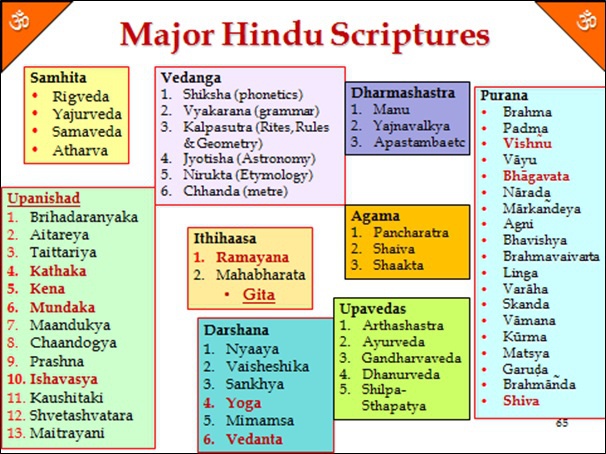
Contributors: Madhukar Adi & Raman Khanna
Location of this post (7c): https://www.hinduspeakers.org/ufaqs/what-are-major-hindu-scriptures/
Category:
07. Scriptures
Vedas are the most authoritative and the root scripture from which others are derived. Vedanta is the end part of the Vedas that consist of the philosophical aspects of vedic teachings. Itihasa and Purana show the practical aspects of how people lived in alignment with Vedic teachings. As questions emerged in the society about the practical aspects of vedas, they were allowed to freely question, meditate, debate and determine a common course/understanding. Summary of such common understanding of the practical aspects of Vedas were then documented in the Smriti’s.
Sri Aurobindo Ghose (1872-1950), Indian mystical and philosopher, put it this way: Hinduism is the most skeptical and the most believing of all religions. It is most skeptical because it has questioned and experimented the most and the deepest, rejecting nothing but insisting on testing and experiencing everything. From this come our scriptures and our beliefs: the Vedas, the Vedanta, the Gita, the Upanishads…But the most authoritative scripture is the heart, where the Eternal has His dwelling.
If you are new to Hinduism or exploring it, the best scripture to start with is Holy Gita. However, the most authoritative are the Vedas.
Other reading material:
Relevant videos: 10 min summary on Gita,
Author; Dilip Amin
Location of this post (7d): https://www.hinduspeakers.org/ufaqs/which-one-is-the-most-authoritative-scripture/
Category:
07. Scriptures
The verse Gita 2:47 reads:
कर्मण्येवाधिकारस्ते मा फलेषु कदाचन ।
मा कर्मफलहेतुर्भूर्मा ते सङ्गोऽस्त्वकर्मणि ॥
Literal meaning: You have the right only to action, never to its results. Do not think yourself the cause of the results of action, and do not be attached to inaction.
- The first phrase, कर्मण्येवाधिकारस्ते (karmaṇy-evādhikāras te), means you are entitled to action alone. As a human being with free will, your “right” lies in doing.
- The second phrase, मा फलेषु कदाचन (mā phaleṣhu kadācana), teaches that you never have ownership of the results. Even if your action contributes to success, the outcome is shaped by many other factors—seen and unseen—beyond your control.
Key insight:
Focusing only on results makes happiness conditional and fragile. If results don’t come, disappointment follows; if they do, fear of losing them sets in. By contrast, giving full attention to meaningful action in the present brings peace, regardless of outcome.
Thus, the Gita’s teaching is not to abandon goals but to act with dedication, without clinging to results. The past belongs to intention, the future to results—but the present moment belongs to action.
Contributor: Manju Gupta
Location of this post (7f): https://www.hinduspeakers.org/ufaqs/what-does-this-mean-ma-phaleshu-kadachana-gita-247/
Category:
07. Scriptures
08. Bhakti
The words bhakti (devotion), bhagavan (god), bhakta (devotee) and bhajan (devotional song) all share the Sanskrit root “bhaj”, which means sharing and participation. The root connotes intense devotion by emphasizing personal experience, relationship, emotional engagement, and expression. A spiritual aspirant feels deep love, or “bhakti,” towards the Divine.
The goal of cultivating Bhakti in one’s heart is the ultimate experience of love that dissolves all boundaries between the individual and the external world, feeling a sense of divine oneness and harmony with all living beings.
Bhakti comes in many flavors, and causes a devotee to completely forget oneself. According to some Hindu schools of thought, there are five kinds of underlying emotions that can arise when feeling devotion towards the Lord: Shanta (peaceful devotion), Dasya (servitude), Sakhya (friendship), Vatsalya (parental love) and Madhurya (romantic love).
Historically, the expression of the beautiful sentiment of Bhakti brought about a change in the way religion was accessed in India. It made religion available to all people regardless of gender, language, or social status. We have evidence of this as early as in the 5th century in South India, with the devotional poetry of the Tamil Nayanars (Shiva worshippers) and Alvars (Vishnu worshippers). Common themes in these poems include love, service and grace. This marked the beginning of the Bhakti Movement, a time period which gave voice to countless devoted men and women throughout the Indian Subcontinent. The devotional songs of these poet-saints, such as Kabir, Mirabai, and Saint Thyagaraja live long after their physical passing, carrying on the spirit of their soulful love and longing for God.
In modern times, the path of devotion (bhakti marga or yoga) is followed by many Hindus worldwide. This is practiced in conjunction with the path of knowledge (jnana marga). While a devotee enjoys devotional songs that help reflect on their personal relationship with Lord Krishna when in bhakti marga, another day they might engage in philosophical discussions on life’s most meaningful questions in the spirit of jnana marga (Knowledge Yoga).
Other reading material: Bhakti Yoga,
Relevant videos: Swami Nikhil Anand Hinduism Q & A: What is Devotion or Bhakti , Bhakti on a street of San Francisco
Contributor: Lakshmi Subramanian
Location of this post (8a): https://www.hinduspeakers.org/ufaqs/what-is-devotion-or-bhakti/
Category:
08. Bhakti
25. Caste System
Gita predates the modern British imperial social construct of Caste, thus Gita has no mention of caste. However, Gita talks extensively about varna and gunas but that is not caste.
In Bhagawad Gita Lord Krishna says, “According to the three modes of material nature and the work ascribed to them, the four divisions of human society were created by Me.” (BG 4:13) Then He continues, “Brahmans, Kshatriyas, Vaishyas and Sudras are distinguished by their qualities of work in accordance with the modes of nature.” (BG 18:41)
It is important to observe that there is no mention of birth as a determining factor for one’s varna or classification. They are ascertained by their quality of work.
Lord Krishna adds, “By following his qualities of work, every man can become perfect… By worship of the Lord, who is the source of all beings and who is all-pervading, man can, in the performance of his own duty [or occupation], attain perfection.” (BG 18:45-46).
Forced designation or untouchability was never a part of the Vedic process.
Source: https://www.stephen-knapp.com/casteism.htm
Other reading material: https://www.hinduamerican.org/all-about-caste
Relevant videos:
Contributor: Dilip Amin
Location of this page (25b): https://www.hinduspeakers.org/ufaqs/what-does-gita-say-about-the-caste-system/
Category:
25. Caste System