Simple answers to your questions on Hinduism are provided here.
Use the search button (top right on desktop, top left on smartphones) to find specific topics of interest. At the bottom of each answer, check the “Tags” section for related topics. To learn more about this Q&A project, click [here].


On Hinduism
You can also download an earlier collection: 300QAs on Hinduism (PDF). Thank you.

07. Scriptures
No. However, there are numerous Hindu texts that hold the equivalent importance amongst Hindus. Vedas, Upanishads, Puranas are some examples. Then, there are some others such as The Bhagavad Gita. In the vast Hindu scholarship, an attempt to cast one book as the “Bible of Hindus” will probably be a fruitless pursuit.
.Other reading material: Short answers to real questions about Hinduism
Relevant videos:
Contributor: Rajeev Singh
Location of this post (7a): https://www.hinduspeakers.org/ufaqs/do-hindus-have-a-bible/
Category:
07. Scriptures
Just like the Bible and Quran are the fundamental scriptures for Christianity and Islam, the Vedas are Hinduism’s oldest and most important scriptures. Vedas are meditations that explore the nature of reality, or the “Truth”, and are classified into 4 books. Each of the 4 Vedas have 4 sections:
- Samhitas – Hymns
- Brahmanas – Priestly Manuals
- Aranyakas – Forest treatises
- Upanishads – Enlightened Discourses
Upanishads are also known as Vedanta, that which comes at the end of the Vedas. They are the metaphysical discourses that are usually in an entertaining story format, with a teacher and a student, exploring the nature of “Truth”.
Upanishad, the word literally means “come sit near”. The seers of the Vedic age were used to giving public talks (similar to the stories of the Buddha giving large sermons). However, not all the secrets can be revealed to a crowd. If Einstein were asked to explain the Theory of Relativity to a crowd at the Madison Square Garden, he would likely give a lighter-weight TED-talk on his findings. Crowds do not understand nuance.
The Truth (ultimate truth) is subtle. Understanding the truth requires a preparation of the body, mind and spirit. When the student is ready, the teacher would ask the student to “come sit near”, so the truth may be revealed with clarity and precision. The Upanishads record the Truth with nuance, clarity and precision. It is best to approach these texts with reverence and a reasonable estimation of one’s readiness.
.
Other reading material: Book-The Upanashads by Eknath Easwaran,
Relevant videos:
Contributor: Madhu
Location of this post (7b): https://www.hinduspeakers.org/ufaqs/what-are-the-upanishads-about/
Category:
07. Scriptures
Hinduism has a long line of scriptural traditions that continue to evolve to this day.
Hinduism’s core scriptures are Shruti (that which is heard, eg. Vedas), Smriti (that which is remembered, Manusmriti), Itihasa (Ramayana and Mahabharata) and Puranas. The Upanishads are also Shruti, which are sublime philosophical meditations on the nature of reality, the Self (Atma), and the permanent and unchanging Brahman (Divinity/God/God substance). Within the Mahabharata is actually contained the Bhagavad Gita, perhaps the text most familiar to non-Indians/Hindus, which describes paths for liberation and also elaborates on both righteous duty (dharma) and the states of detachment (vairagya) under which such duty needs to be undertaken.
Even after these original scriptures were composed, Hindus continued to create new variants. The Ramayana itself has been adapted multiple times with minor and major variations, including in Hindi as the Ramacharitmanas of Tulsidas. Many other religious texts have developed in various sampradayas, panths, maths, and other religious organizations which are too numerous and substantial to summarize here.
The Hindu corpus is alive, not just through the reinterpretation of old scriptures but in the writing of new scriptures.
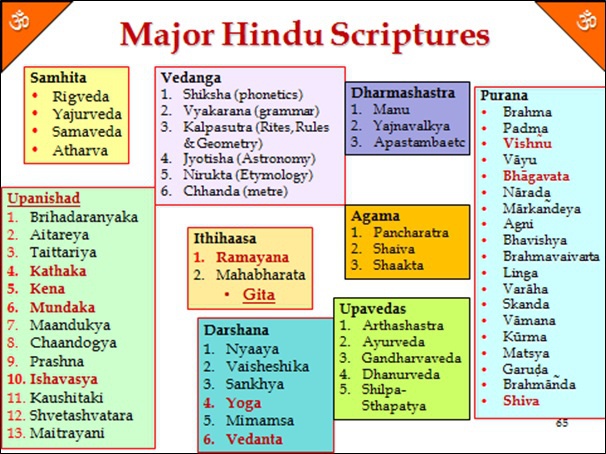
Contributors: Madhukar Adi & Raman Khanna
Location of this post (7c): https://www.hinduspeakers.org/ufaqs/what-are-major-hindu-scriptures/
Category:
07. Scriptures
11. Commandments
Hinduism does not have a single doctrine that all Hindus must believe. Instead, it embraces a diversity of traditions and philosophies. Still, there are several core ideas that many (though not all) Hindus hold:
- Authority of the Vedas – The Vedas are regarded as sacred and foundational texts.
- Role of the Guru – A spiritual teacher (guru) is considered important for guiding one’s journey.
- Reincarnation – The soul (ātman) is reborn in different lives.
- Law of Karma – Every action has consequences, both moral and physical, that shape future experiences.
- Nature of Divinity – The Divine can be experienced in two ways:
- Saguna Brahman: with attributes and forms, making it easier for devotion and worship.
- Nirguna Brahman: beyond attributes, beyond description, and ultimately ineffable.
Other reading material:
Relevant videos:
Contributor: Raman Khanna
Location of this post (11b): https://www.hinduspeakers.org/ufaqs/what-are-hinduisms-doctrines/
Category:
11. Commandments