Simple answers to your questions on Hinduism are provided here.
Use the search button (top right on desktop, top left on smartphones) to find specific topics of interest. At the bottom of each answer, check the “Tags” section for related topics. To learn more about this Q&A project, click [here].


On Hinduism
You can also download an earlier collection: 300QAs on Hinduism (PDF). Thank you.
02. God Forms
In Hindu temples, homes, and countless folktales, you will hear of Hanuman, “the Monkey God”. What is important about him is neither that he’s a “monkey” nor that he is considered a divinity or “God”; he is revered as a powerful heroic figure filled with devotional surrender.
Hanuman is one of the dearest deities in the Hindu tradition, imbued with valor, mischief, strength, and devotion. He is the personification of strength and devotion, and that is why his tales are loved all over the world.
Hanuman in Ramayana
It is his complete Devotion that sets him apart. The story of Hanuman comes to us from Ramayana, the earlier of the two major epics in Hinduism (the other being the Mahabharata). In the epic, Lord Sri Rama, (God incarnate in human form) is engaged in an epic battle with the king of Lanka, who has wrongfully kidnapped his wife. Hanuman is part of a tribe of monkeys that meet Sri Rama, and this ragtag army of monkeys help Sri Rama (and his younger brother, Lakshmana) win against the rich, mighty and arrogant Ravana.
Hanuman as Yogi
Hanuman is a complete yogi. One of his names is Bajrang (or Vajra-anga, the thunderbolt Bodied one), which is one of the highest achievements for a yogi, to have a thunderbolt energy body (in yoga the subtle body is an energy body). He is the son of the Wind, a reference also to his mastery of the breath, which you know as Pranayama. He has all the mystical powers that a yogi can acquire (there are eight siddhis, or yogic superpowers, such as the ability to be tiny, heavy, fly, and so on). He is also the symbol of Bhakti Yoga, the yoga of devotion, being completely surrendered to his master. So Hanuman is the complete yogi, with excellence in all the yogas of Action, Meditation, and Devotion.
Hanuman Chalisa
Many western adherents to the Bhakti tradition (like the singer Krishna Das) make it a point to memorize the Hanuman Chalisa, the forty verses in praise of Hanuman. Singing the Chalisa is a tradition followed all over India, and a large percentage of modern Hindus will be able to recite and chant along. The chanting of the Hanuman Chalisa brings joy, relief, and a connection with a powerful-yet-surrendered Yogi. Something we should all aspire to become.
Sundar Kand
There are many fun stories associated with Hanuman. Let me tell you just one. He was born with immense powers but was very playful as a child. After one such naughty episode, he was cursed to forget all his powers. He would stay forgetful until someone reminds him. As it happens, he is reminded of his powers at a pivotal point in the epic, when someone is needed to cross the Ocean to go to the island of Lanka to look for Rama’s wife. This is the beginning of some of the most beautiful poetry in the epic, and even today many Hindus chant the “Sundar Kand”, (beautiful chapter) which describes the exploits of Hanuman in Lanka.
We all have powers that we don’t remember. A mentor or coach can help us by reminding us of our own super-powers. Isn’t that a memorable story?
Ask for His help!
Hanuman is one of the few Chiranjeevis in the Hindu tradition (Chiran-jeevi means “lives forever”), and it is said that he still roams this Earth and comes to help when he is invoked.
Other reading material: Hindu God Hanuman,
Relevant videos: Krishna Das on Hanuman Chalisa
Contributor: Gaurav Rastogi
Location of this post (2b): https://www.hinduspeakers.org/ufaqs/can-you-explain-more-about-the-monkey-god-hanuman/
Category:
02. God Forms
07. Scriptures
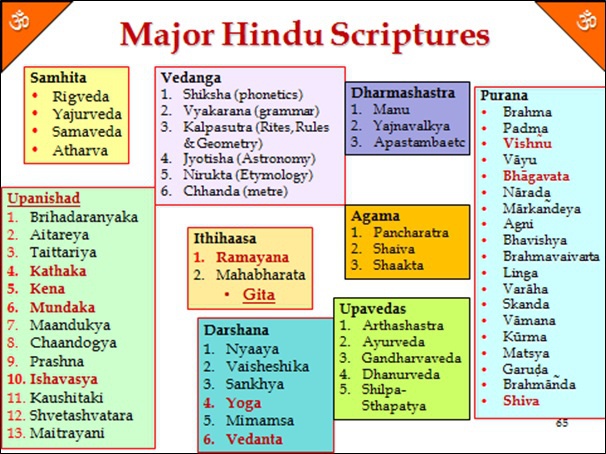
Hinduism has a long line of scriptural traditions that continue to evolve to this day.
Hinduism’s core scriptures are Shruti (that which is heard, eg. Vedas), Smriti (that which is remembered, Manusmriti), Itihasa (Ramayana and Mahabharata) and Puranas. The Upanishads are also Shruti, which are sublime philosophical meditations on the nature of reality, the Self (Atma), and the permanent and unchanging Brahman (Divinity/God/God substance). Within the Mahabharata is actually contained the Bhagavad Gita, perhaps the text most familiar to non-Indians/Hindus, which describes paths for liberation and also elaborates on both righteous duty (dharma) and the states of detachment (vairagya) under which such duty needs to be undertaken.
Even after these original scriptures were composed, Hindus continued to create new variants. The Ramayana itself has been adapted multiple times with minor and major variations, including in Hindi as the Ramacharitmanas of Tulsidas. Many other religious texts have developed in various sampradayas, panths, maths, and other religious organizations which are too numerous and substantial to summarize here.
The Hindu corpus is alive, not just through the reinterpretation of old scriptures but in the writing of new scriptures.
Contributors: Madhukar Adi & Raman Khanna
Location of this post (7c): https://www.hinduspeakers.org/ufaqs/what-are-major-hindu-scriptures/
Category:
07. Scriptures
24. Women in Hinduism
The Ramayana is, perhaps first and foremost, the tale of a man who strives to constantly live up to his ideals but is forced to, like all of us, live in an unideal world. It is through this lens, then, that we may understand his choice to banish Sita, a choice that resulted from a situation in which there was no good option.
Rama’s people, mistakenly believing that Sita was “impure”, demanded that she be banished. As King of his people, Rama’s duty was to follow the will of the people as mandated by Hindu scriptures, whatever the will of the people may be (Indian kingship was much more democratic than European kingships, with the ideal Indian king simply serving as an executor of the people’s will rather than someone with absolute power). Thus, as the people demanded that his wife be banished, Rama faced a dilemma: to follow the duty of a husband and stand by his wife, or to follow the duty of a Dharmic king and obey his people. He chose the latter, giving an insight into the Hindu belief that the matters of the nation stand above one’s personal life, and also giving a poignant glimpse into the hardships that leaders face, perhaps even till this day.
What is important to note, however, is that while he decided to fulfill the duty of a king, he tried his level best to fulfill the duty of a husband as well: though he easily could have, he never remarried, and lived out the rest of his life dedicated to the service of his people.
Sita herself did not fault Ram Bhagwan. Her tears were for Ram Bhagwan’s pain to have to banish her and not for her own pain. She understood and sympathized with what he had to do. She was an exemplary bhakta of Bhagwan and a faithful wife. Sita passed the Agni Pariksha (fire test) but later prayed to Mother Earth (Bhūmi Devi), her divine mother, to take her back. The earth opened, and Sita was embraced by Bhūmi Devi. She disappeared into the earth, never to return.
This story serves as an example of how good people can be forced into situations where there is no right answer, and to Hindus around the world, provides some guidance for how to address these issues as well.
Other reading material: Bulbul @ New India Abroad, Many Ramayanas, Many Lessons A book by Anand Neelakantan,
Relevant videos:https://youtu.be/qA_Plb_Tspg?t=1596, https://www.youtube.com/watch?v=R_4s1eVLptA&list=PLWsnhdZKqEqyHyRAAO5P-mDnLg9mUlH1u&index=10 , Ami Ganatra on Sita, Dr.. Kumar Vishwas, Manoj Muntashir, Tilak video on Sita,
Contributor: Rutvij Horay
Location of this document (24b): https://www.hinduspeakers.org/ufaqs/why-was-sita-tested-by-rama
Category:
24. Women in Hinduism