Simple answers to your questions on Hinduism are provided here.
Use the search button (top right on desktop, top left on smartphones) to find specific topics of interest. At the bottom of each answer, check the “Tags” section for related topics. To learn more about this Q&A project, click [here].


On Hinduism
You can also download an earlier collection: 300QAs on Hinduism (PDF). Thank you.

03. General
Hinduism is the oldest major religion. Hindus have scriptures, have temples in most countries and one in seven people on this earth is a Hindu.
If you are trying to understand Hinduism with Abrahamic viewpoints, it will get confusing. For example, Hinduism has 1) no founder, 2) has no beginning or projected end, 3) has no commandment but have Dharmic guidance, 4) has no central authority, like Pope, 5) has no apostle (to whom God talked to) but have many learned Rishis and Gurus, and 6) has not “The” Scripture like Torah, Bible and Koran, but have Veda, Upanishad, Gita, Ramayana, and more.
The word “religion” comes from the Latin word Re-Ligare, meaning Re-connect with God. That word serves the Abrahamic ideology that God and human beings are physically separate entities and will get re-connected on Judgment Day. Contrary to that, fundamental Hinduism belief is–God and human beings are inseparable. The day soul (Atman or God) leaves us, our worthless dead body remains. In this respect, the word Re-Ligion is not technically applicable to the Hindu belief system.
.
In many senses, Hinduism is not a religion but it’s a righteous way of living. It’s originally called Sanatana Dharma, the law and order that holds value at all times for the entire mankind. Anyone can follow the principles of Hinduism without being born as a HIndu. No one in a real sense is called a Hindu but you can practice the principles of Hinduism. By practicing principles you don’t become a Hindu but you have become a practitioner of principles of Hinduism. These principles can be anywhere from performing rituals for materialistic benefits to spiritual evolution of realizing Self. Hinduism embraces various philosophies and is also considered as the mother of all religions.
.Other reading material:
Relevant videos: Swami Chinmaya Nanda, Satguru Bodhinatha,
Contributor: Dilip Amin
Location of this post (3c): https://www.hinduspeakers.org/ufaqs/is-hinduism-a-religion/
Category:
03. General
In the West, often the material prepared to teach Hinduism has not been created by practitioners of the religion and thus lacks the understanding that only comes from actually living the tradition. Further, people (including Hindu youths in the West) exposed to Abrahamic faiths have certain expectations from a religion. Such comparative religion knowledge seekers get confused when they don’t find a specific answer in Hinduism. For example, Hinduism doesn’t have an origin, has no founder, has no commandment but provides lots of guidance. It has no “the” scripture but has a wealth of scriptures. Because of its wealth of scholarship, and traditions of many millenia, it takes time to appreciate the richness of Hinduism.
Other reading material:
Relevant videos: https://www.youtube.com/watch?v=CWLf5qGmIhI
Contributor: Dilip Amin
Location of this post (3d): https://www.hinduspeakers.org/ufaqs/why-is-hinduism-difficult-to-understand/
Category:
03. General
12. Origin
Abrahamic concept of creation of the world is it was created in seven days or dissolution of it on the Judgment Day. Hindus believe this universe is the result of a continuous process of creation and dissolution. The universe was there billions of years before and it will still be there after billions of more years; though it will continuously be changing.
When creation happens, the unmanifest becomes manifest, takes a form. When dissolution happens, the manifest becomes unmanifest.
According to Shrimad Bhagwad Gita, there was no time when Bhagwan Krishna was not there and there was no time when Arjun was not there. The only difference was that Bhagwan Krishna remembered all His births while Arjun did not.
Other reading material:
Relevant videos:
Contributor: Dilip Amin
Location of this page:(12b): hinduspeakers.org/ufaqs/what-is-the-hindu-concept-of-creation/
Category:
12. Origin
14. Afterlife
Rest in Peace (RIP) is an Abrahamic concept, as per which the body waits or rests in a grave. On Judgement Day, the body gets united with the soul and rises again. God will make judgement for who will go to heaven or eternal hell.
Hindus believe in reincarnation of the departed soul to a new body and soul does not rest. Hindus have a concept that if the soul is trapped inside the earth, then it’s called as a Preta (a disturbed soul and in suffering). Suffering in Hell is better as it’s temporary, but not getting trapped here. Thus to tell RIP is a disrespect to the departed Hindu.
“Param Gati Mile” (may the soul attain moksha), “Om Sadagati” and “Om Shanti” are appropriate expressions when a Hindu passes away.
Other reading material: Here is why saying ‘Rest in Peace’ is a disservice to the departed Hindu soul,
Relevant videos:
Contributor: Dilip Amin
Location of this post (14a): https://www.hinduspeakers.org/ufaqs/is-rip-an-appropriate-expression-for-a-departed-hindu/
Category:
14. Afterlife
29. Other Faiths
Since the inner intent of all religions is to bind man back to God, Hindus seek not to interfere with anyone’s faith or practice. We believe that there is no exclusive path, no one way for all. Hindus profoundly know that God is the same supreme being in whom peoples of all faiths find solace, peace and liberation. None the less we realize that all religions are not the same.
Each has its unique beliefs, practices, goals, and paths of attainment, and the doctrines of one often conflict with those of another. Even this should never be a cause for religious tension and intolerance.
Hindus respect all religious traditions and the people within them.
Modified from the original source: Sadguru Sivaya Subramuniyaswami of Kauai Hindu monastery.
Other reading material:
Relevant videos:
Contributor: Jyoti Lulla
Location of this page (29b): https://www.hinduspeakers.org/ufaqs/what-is-a-hindus-attitude-towards-other-faith-beliefs/
Category:
29. Other Faiths
Main differences between three Abrahamic and four Dharmic faiths are summarized in this table. This is a high level general guidance. Not all religions follow these beliefs equally (example: circumcison).
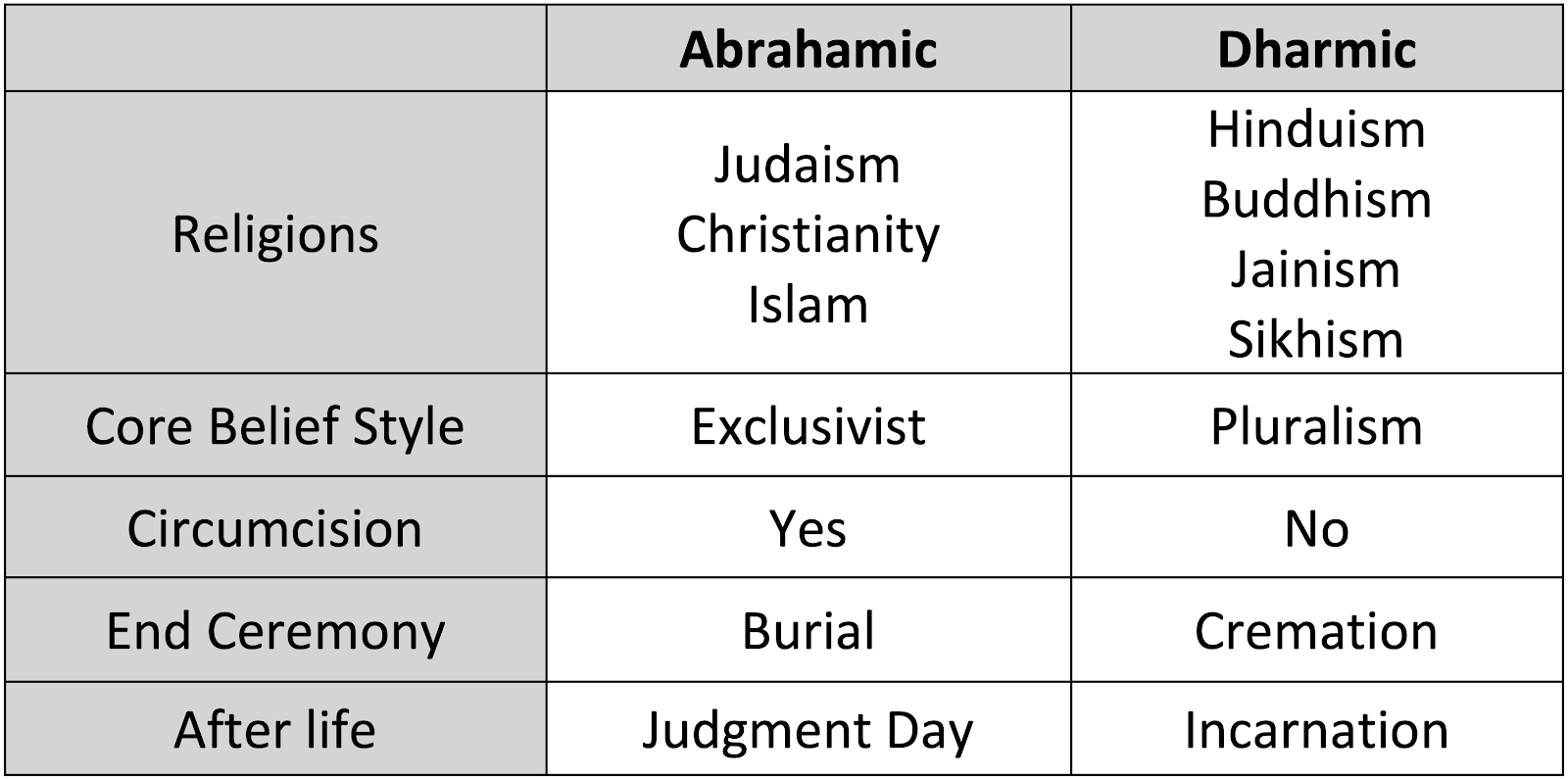
Source: From the Book-Interfaith Marriage: Share and Respect with Equality by Dilip Amin
Other reading material: Being Different, An Indian Challenge to Western Universalism, by Rajiv Malhotra. HarperCollins Publication.
Relevant videos
Contributor: Dilip Amin
Location of this page (29c): hinduspeakers.org/ufaqs/z-what-are-the-main-differences-between-abrahamic-and-dharmic-faiths/
Category:
29. Other Faiths