Simple answers to your questions on Hinduism are provided here.
Use the search button (top right on desktop, top left on smartphones) to find specific topics of interest. At the bottom of each answer, check the “Tags” section for related topics. To learn more about this Q&A project, click [here].


On Hinduism
You can also download an earlier collection: 300QAs on Hinduism (PDF). Thank you.
05. Traditions
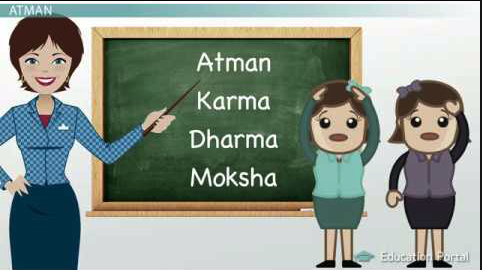
The basic tenets of Hinduism that all Hindus believe in are the concepts of:
- Dharma: Dharma is laws and order by which this universe is sustained. Dharma is the mode of conduct for an individual that is most conducive to spiritual advancement.
- Karma: We are responsible for our actions. Sometimes, we might not understand the events of life, but they are the sum total of our karma over multiple lifetimes. However, our past karma only decides some situations in life (prarabdha), we still have control over our karma in this lifetime, and all our life in this lifetime is not predestined.
- Atman/Soul: meaning that there is a light within each living being and that we are beyond our physical bodies. The Atman cannot be killed or destroyed, only the physical body can be destroyed.
- Kaal chakra (Samsara, Wheel of life): meaning that there is a continuous cycle of birth, death and rebirth.
- Moksha: That it is possible for human beings to realize their true nature and be one with their soul while in their physical body. Once the self realization happens, then one is said to attain moksha, and become free from the cycle of birth and death.
Other reading material:
Relevant videos:
Contributor: Swati Sugandhi
URL link of this page (5b): https://www.hinduspeakers.org/ufaqs/what-are-basic-tenets-of-hinduism/
Category:
05. Traditions
09. Dharma
- Whole world is one family. All have to live together, cooperate, assimilate and enjoy each other.
- Practice Ahimsa (non-cruelty) towards all living beings, because everybody has the right to live – “Live and Let Live”.
- Treat every human being like how you would like to be treated.
- God is one and there is nothing else but God. God is omnipresent, omnipotent and omniscient.
- God has created the whole universe and He is present in every particle of the universe.
- God is present everywhere, in all living beings – all humans, all animals, birds, insects. trees, etc. – and in all non-living objects like rivers, oceans, hills etc. and, therefore, everything is worship-able.
- Hindu Dharma is an open minded religion not bound by any incontrovertible pronouncements and rituals.
- Hinduism is not a dogmatic religion. There are no binding rituals and everyone is free to follow or not to follow any particular ritual.
- Hindu Dharma welcomes and accepts noble thoughts from all around the world.
- Hindu Dharma respects all religions and accepts their good points.
- Hindu Dharma believes in non-violence, not to kill any person or animal etc. except in self defense.
- Hindu Dharma believes in moral and ethical values, respect for parents, teachers and elders and knowledgeable persons all around the world.
Other reading material:
Relevant videos
Contributor: Sudhir Gupta
Location of this post (9b): https://www.hinduspeakers.org/ufaqs/what-are-tenets-of-hindu-dharma/
Category:
09. Dharma
11. Commandments
Hinduism is a family of traditions that emphasizes personal experience and evaluation and thus, offers overarching guidelines rather than absolute lists of do’s and don’ts or commandments in regulating individual behavior. For a Hindu, all actions are to be guided by dharma. Hindu ethical values flow from one’s understanding of the nature of reality and inform the Hindu understanding of right and wrong.
To paraphrase Coco Chanel, “Fashion changes, Style is eternal”, Hindus would agree with “Commandments change, but Dharma is forever”.
.
Source: https://www.hinduamerican.org/hinduism-short-answers-real-questions
Relevant videos:
Location of this post (11a): https://www.hinduspeakers.org/ufaqs/do-hindus-have-commandments/
Category:
11. Commandments
Hinduism does not have a single doctrine that all Hindus must believe. Instead, it embraces a diversity of traditions and philosophies. Still, there are several core ideas that many (though not all) Hindus hold:
- Authority of the Vedas – The Vedas are regarded as sacred and foundational texts.
- Role of the Guru – A spiritual teacher (guru) is considered important for guiding one’s journey.
- Reincarnation – The soul (ātman) is reborn in different lives.
- Law of Karma – Every action has consequences, both moral and physical, that shape future experiences.
- Nature of Divinity – The Divine can be experienced in two ways:
- Saguna Brahman: with attributes and forms, making it easier for devotion and worship.
- Nirguna Brahman: beyond attributes, beyond description, and ultimately ineffable.
Other reading material:
Relevant videos:
Contributor: Raman Khanna
Location of this post (11b): https://www.hinduspeakers.org/ufaqs/what-are-hinduisms-doctrines/
Category:
11. Commandments
19. Hindu Life
Hindus have an ethics framework and recommendations but do not have the commandments. They rather have the do’s and don’ts–ten of each. These are called the yamas (restraints) and niyamas (practices). Collectively, these are the code of conduct for Hindus. Restraints are non-injury, truthfulness, non-stealing, divine conduct, patience, compassion, steadfastness, honesty, purity, and moderate appetite. Practices are observances that are a derivative of the restraints. Hindu Ethics are enshrined in the Vedas and Smritis. They were also practically demonstrated by God Himself in the Itihasas and Puranas. Hindu ethics are rooted in these 10 restraints.
Other reading material: https://houseoflac.wordpress.com/2020/09/06/25-yama-and-niyama/
Relevant videos
Contributor: Rajeev Singh
Location of this post (19e): https://www.hinduspeakers.org/ufaqs/what-are-hinduisms-ethical-and-legal-rules/
Category:
19. Hindu Life