Simple answers to your questions on Hinduism are provided here.
Use the search button (top right on desktop, top left on smartphones) to find specific topics of interest. At the bottom of each answer, check the “Tags” section for related topics. To learn more about this Q&A project, click [here].


On Hinduism
You can also download an earlier collection: 300QAs on Hinduism (PDF). Thank you.

02. God Forms
Hindus see the Divine present in all forms of existence. Traditionally, Hindus have worshiped every aspect of nature—elements such as dawn, fire, rain, and oceans; abstract concepts like creation, preservation, and regeneration; and living beings, including animals. Unlike some traditions that discard earlier layers of belief, Hinduism has absorbed and integrated them, so that animal worship and symbolism remain an essential part of Hindu spirituality.
Animals are revered both symbolically and ecologically. Their qualities are used to teach moral, spiritual, and practical lessons. For example:
- Horse – swiftness and energy
- Bull – strength and endurance
- Tiger – courage and fierceness
In anthropomorphic form, this symbolism becomes even more profound:
- Ganesha (elephant-headed) – remover of obstacles, representing memory, group cooperation, and the joy of sharing (like sweets among friends).
- Garuda (eagle) – speed, vision, and protection.
- Hanuman (monkey) – devotion, strength, and humility.
Applying these animal qualities—such as building strong friendships, cultivating memory, or sharing joy—helps individuals navigate life’s challenges.
On an ecological level, reverence for animals fosters respect for biodiversity. For instance, honoring elephants not only safeguards them but also ensures the preservation of vast wild habitats that protect countless other plants and animals. In this way, Hindu traditions encourage ecological balance and highlight the interdependence of all life.
Other reading material: Short answers to real questions about Hinduism
Relevant videos:Contributor: Raman Khanna, Sandeep Tiwari
Location of this post (2h): https://www.hinduspeakers.org/ufaqs/why-are-so-many-hindu-gods-associated-with-an-animal/
Category:
02. God Forms
03. General
There are one billion Hindus, meaning one out of seven people on this earth is a Hindu.
You may be wondering why in this world there are so many religions, names of God, scriptures, etc? Rig Veda explains it this way in Sanskrit… Ekam Sat, Vipra Bahuda vadanti. There is absolutely One Truth (God, Brahman, Atman…), but the sages call it by many names.
Hindus have liberty to see God in any number of ways. Most Hindus pray to God in many forms as Devis and Devtas. They are not gods but are divine manifestations of God. To use an analogy, if God is Sun then these Devis and Devtas are sun-rays.
Another way of looking at it—assume God as a big government. The finance department is managed by Goddess Laxmi and the education department by Goddess Saraswati. Hindus pray to Lord Ganesh to remove obstacles in life and take guidance from Lord Krishna for how to live a good life.
To seek God, one does not have to look outside but inside. God is sitting inside us, that is your soul or atman. The day God leaves you, your worthless dead body remains. Hindus believe in reincarnation; meaning after death, the soul moves to a new body.
We have many ways to unite or yoga with God, like meditation—Raja Yoga, knowledge—Gnana Yoga, service to others—Karma Yoga and the most popular being the Bhakti Yoga. The Bhakti yoga can be performed at home or at a mandir along with certain rituals.
God is omnipresent. Namaste means I see divinity in you and bow to you. Further, God’s kingdom includes animals, plans, mother earth, sun and moon. We do not have doctrines, like–thou shall not eat beef. Hinduism teaches us to follow our Dharma and follow a non-violent path. Further, it teaches us that animals have a right to life, just as all humans do. Hence, there is an inclination towards vegetarianism.
Important aspect of Hinduism is how to live material life righteously and evolve spiritually which is covered in 4 Purushartas–Dharma, Artha, Kama and Moksha.
We have many scriptures, like Vedas, Upanishads, Puranas, etc. Gita is one of the better known texts and can be considered a self-improvement guide. It teaches us how to be happy in this life and teaches us to do good karma without expectations of fruits.
Hari Om.
.Other reading material: Short answers to real questions about Hinduism,
Relevant videos: Spiritual Growth through Faith – Hinduism by Mukta Vadera, Living with faith-Dilip Amin, Hinduism by Dilip Amin,
Contributor: Dilip Amin
Location of this post (3b): https://www.hinduspeakers.org/ufaqs/introduction-to-hinduism/
Category:
03. General
Hinduism is the oldest major religion. Hindus have scriptures, have temples in most countries and one in seven people on this earth is a Hindu.
If you are trying to understand Hinduism with Abrahamic viewpoints, it will get confusing. For example, Hinduism has 1) no founder, 2) has no beginning or projected end, 3) has no commandment but have Dharmic guidance, 4) has no central authority, like Pope, 5) has no apostle (to whom God talked to) but have many learned Rishis and Gurus, and 6) has not “The” Scripture like Torah, Bible and Koran, but have Veda, Upanishad, Gita, Ramayana, and more.
The word “religion” comes from the Latin word Re-Ligare, meaning Re-connect with God. That word serves the Abrahamic ideology that God and human beings are physically separate entities and will get re-connected on Judgment Day. Contrary to that, fundamental Hinduism belief is–God and human beings are inseparable. The day soul (Atman or God) leaves us, our worthless dead body remains. In this respect, the word Re-Ligion is not technically applicable to the Hindu belief system.
.
In many senses, Hinduism is not a religion but it’s a righteous way of living. It’s originally called Sanatana Dharma, the law and order that holds value at all times for the entire mankind. Anyone can follow the principles of Hinduism without being born as a HIndu. No one in a real sense is called a Hindu but you can practice the principles of Hinduism. By practicing principles you don’t become a Hindu but you have become a practitioner of principles of Hinduism. These principles can be anywhere from performing rituals for materialistic benefits to spiritual evolution of realizing Self. Hinduism embraces various philosophies and is also considered as the mother of all religions.
.Other reading material:
Relevant videos: Swami Chinmaya Nanda, Satguru Bodhinatha,
Contributor: Dilip Amin
Location of this post (3c): https://www.hinduspeakers.org/ufaqs/is-hinduism-a-religion/
Category:
03. General
In the West, often the material prepared to teach Hinduism has not been created by practitioners of the religion and thus lacks the understanding that only comes from actually living the tradition. Further, people (including Hindu youths in the West) exposed to Abrahamic faiths have certain expectations from a religion. Such comparative religion knowledge seekers get confused when they don’t find a specific answer in Hinduism. For example, Hinduism doesn’t have an origin, has no founder, has no commandment but provides lots of guidance. It has no “the” scripture but has a wealth of scriptures. Because of its wealth of scholarship, and traditions of many millenia, it takes time to appreciate the richness of Hinduism.
Other reading material:
Relevant videos: https://www.youtube.com/watch?v=CWLf5qGmIhI
Contributor: Dilip Amin
Location of this post (3d): https://www.hinduspeakers.org/ufaqs/why-is-hinduism-difficult-to-understand/
Category:
03. General
Hinduism or Sanatana Dharma (Eternal Path) is the oldest religion and it originated in the Indian subcontinent (current day India-Pakistan-Bangladesh-Afghanistan-Nepal-Bhutan). It is a sum total of various Indic philosophies and ways of life of the people in the Indian subcontinent. Even though the cultural values vary among different traditions within Hinduism, the common threads of four values binds all the traditions together:
Dharma: The law of the cosmos/true path. On an individual level, one’s personal duty.
Karma: Action (Papa and Punya)
Sansara: Cycle of life (birth-death-rebirth)
Moksha: Liberation of the soul (Atma) from Sansara (the cycle of life and death)
Other reading material:
Relevant videos:
Contributor: Swati Sugandhi
Location of this post (3f): https://www.hinduspeakers.org/ufaqs/how-is-hinduism-defined/
Category:
03. General
11. Commandments
Hinduism does not have a single doctrine that all Hindus must believe. Instead, it embraces a diversity of traditions and philosophies. Still, there are several core ideas that many (though not all) Hindus hold:
- Authority of the Vedas – The Vedas are regarded as sacred and foundational texts.
- Role of the Guru – A spiritual teacher (guru) is considered important for guiding one’s journey.
- Reincarnation – The soul (ātman) is reborn in different lives.
- Law of Karma – Every action has consequences, both moral and physical, that shape future experiences.
- Nature of Divinity – The Divine can be experienced in two ways:
- Saguna Brahman: with attributes and forms, making it easier for devotion and worship.
- Nirguna Brahman: beyond attributes, beyond description, and ultimately ineffable.
Other reading material:
Relevant videos:
Contributor: Raman Khanna
Location of this post (11b): https://www.hinduspeakers.org/ufaqs/what-are-hinduisms-doctrines/
Category:
11. Commandments
14. Afterlife
According to Hinduism, Yes!
Hinduism is deeply rooted in the concept of Karma and reincarnation. Destiny is defined as a predetermined course of events (in general or in an individual’s life) as planned by Divine will. Hindus believe that such a predetermined course is created by an individual through his or her actions or “karma” in one’s present life or past lives; as choosing good karma produces good effects on the actor, while choosing the bad karma produces bad effects in present or future lives.
Destiny therefore is the result of the past exercise of the actor’s choice. By choosing the actions in the past, an individual brings on the resultant destiny in this life. Similarly, by choosing good actions in the present, one can change the course of present life and in future reincarnations.
.
Sri Aurobindo, wrote (Dec 16, 1936): “We ourselves are our own fate through our actions, but the fate created by us binds us; for what we have sown, we must reap in this life or another. Still we are creating our fate for the future even while undergoing old fate from the past in the present. That gives a meaning to our will and action…”.
In Mahabharata, destiny and karma are explained with examples of seeds: “Without seeds, fruits do not grow. Good seeds when sown yield good fruits. Bad seeds when sown yield weeds and bad fruits. If no seeds are sown, there are no fruits. Without exertion in this life, destiny is meaningless. One’s exertion now is like a tilled soil; the seeds are like destiny. The union of tilled soil and seeds, that is one’s present effort and destiny inside the seed, produces the harvest.
He who exerts with initiative is his own best friend, he who relies solely on destiny is his own worst enemy.” [Sri Aurobindo and the Mother, The Hidden Forces of Life, Ch. 1 Life Through the Eyes of the Yogin, pp.13-14].
.
Other reading material:
Relevant videos: Swami Nikhil Anand Hinduism Q & A: Can Destiny be Changed
Contributor: Ashis Khan
Location of this post (14c): https://www.hinduspeakers.org/ufaqs/can-destiny-be-changed/
Category:
14. Afterlife
29. Other Faiths
Main differences between three Abrahamic and four Dharmic faiths are summarized in this table. This is a high level general guidance. Not all religions follow these beliefs equally (example: circumcison).
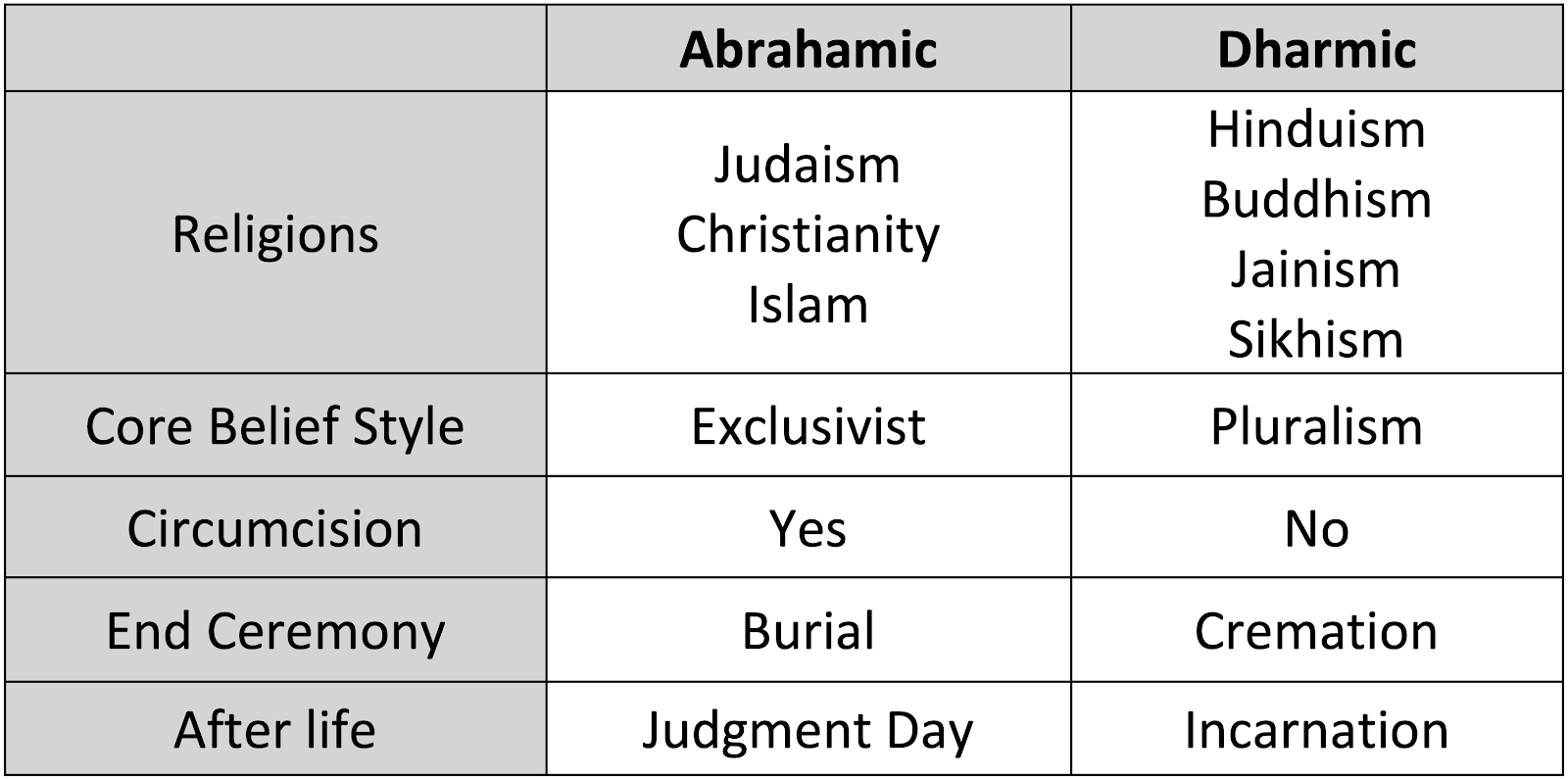
Source: From the Book-Interfaith Marriage: Share and Respect with Equality by Dilip Amin
Other reading material: Being Different, An Indian Challenge to Western Universalism, by Rajiv Malhotra. HarperCollins Publication.
Relevant videos
Contributor: Dilip Amin
Location of this page (29c): hinduspeakers.org/ufaqs/z-what-are-the-main-differences-between-abrahamic-and-dharmic-faiths/
Category:
29. Other Faiths