Simple answers to your questions on Hinduism are provided here.
Use the search button (top right on desktop, top left on smartphones) to find specific topics of interest. At the bottom of each answer, check the “Tags” section for related topics. To learn more about this Q&A project, click [here].


On Hinduism
You can also download an earlier collection: 300QAs on Hinduism (PDF). Thank you.
03. General
Hinduism is the oldest major religion. Hindus have scriptures, have temples in most countries and one in seven people on this earth is a Hindu.
If you are trying to understand Hinduism with Abrahamic viewpoints, it will get confusing. For example, Hinduism has 1) no founder, 2) has no beginning or projected end, 3) has no commandment but have Dharmic guidance, 4) has no central authority, like Pope, 5) has no apostle (to whom God talked to) but have many learned Rishis and Gurus, and 6) has not “The” Scripture like Torah, Bible and Koran, but have Veda, Upanishad, Gita, Ramayana, and more.
The word “religion” comes from the Latin word Re-Ligare, meaning Re-connect with God. That word serves the Abrahamic ideology that God and human beings are physically separate entities and will get re-connected on Judgment Day. Contrary to that, fundamental Hinduism belief is–God and human beings are inseparable. The day soul (Atman or God) leaves us, our worthless dead body remains. In this respect, the word Re-Ligion is not technically applicable to the Hindu belief system.
.
In many senses, Hinduism is not a religion but it’s a righteous way of living. It’s originally called Sanatana Dharma, the law and order that holds value at all times for the entire mankind. Anyone can follow the principles of Hinduism without being born as a HIndu. No one in a real sense is called a Hindu but you can practice the principles of Hinduism. By practicing principles you don’t become a Hindu but you have become a practitioner of principles of Hinduism. These principles can be anywhere from performing rituals for materialistic benefits to spiritual evolution of realizing Self. Hinduism embraces various philosophies and is also considered as the mother of all religions.
.Other reading material:
Relevant videos: Swami Chinmaya Nanda, Satguru Bodhinatha,
Contributor: Dilip Amin
Location of this post (3c): https://www.hinduspeakers.org/ufaqs/is-hinduism-a-religion/
Category:
03. General
Hinduism or Sanatana Dharma (Eternal Path) is the oldest religion and it originated in the Indian subcontinent (current day India-Pakistan-Bangladesh-Afghanistan-Nepal-Bhutan). It is a sum total of various Indic philosophies and ways of life of the people in the Indian subcontinent. Even though the cultural values vary among different traditions within Hinduism, the common threads of four values binds all the traditions together:
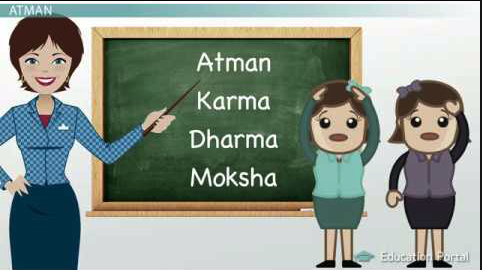
Dharma: The law of the cosmos/true path. On an individual level, one’s personal duty.
Karma: Action (Papa and Punya)
Sansara: Cycle of life (birth-death-rebirth)
Moksha: Liberation of the soul (Atma) from Sansara (the cycle of life and death)
Other reading material:
Relevant videos:
Contributor: Swati Sugandhi
Location of this post (3f): https://www.hinduspeakers.org/ufaqs/how-is-hinduism-defined/
Category:
03. General
04. Name Hinduism
Hinduism is third largest and the world’s most ancient religion with over 5000 years old history. Hinduism is most popularly known as Sanatan dharma or Vedic dharma. Sanatan literally in English means “eternal”. Dharma is duty, virtue and morality, and it refers to the power which upholds the universe and society. The very reason it is called Sanatana (eternal) is because no one knows how and when it started.
While the origin of most religions can be traced back to a certain person, like Christianity starts with Jesus Christ and the idea of Islam was propagated by Prophet Muhammad, no body can point out a certain person who started the idea of Sanatana Dharma.
.
Other reading material: Short answers to real questions about Hinduism, http://veda.wikidot.com/dharma
Relevant videos: Swami Nikhil Anand Hinduism Q & A: What is the Original Name Of Hinduism,
Contributor: Nilesh Chaudhary
Location of this post (4a): https://www.hinduspeakers.org/ufaqs/what-is-the-original-name-of-hinduism/
Category:
04. Name Hinduism
Sanatan translates to eternal. Dharma is universal order and conformity to natural righteousness.
Saints and seers of India codified their experienced spirituality into the ethics, arts, sciences, architecture, food, practices, and rituals based on the observation of the order in the universe around them – something that has always existed and is eternal. Hence the term Sanatan Dharma, which is too broad to be any kind of an “ism”.
Hinduism is a modern term invented after ”Indus” valley civilization which compromises the essence of Sanatan Dharma.
Other reading material: Short answers to real questions about Hinduism, Rajeev Singh: About Sanatan Dharma
Relevant videos: Swami Nikhil Anand Hinduism Q & A: What is the Original Name Of Hinduism, What is Sanatan Dharma?,
Contributor: Geetha Ravula
Location of this post (4b): https://www.hinduspeakers.org/ufaqs/why-do-people-use-sanatan-dharma-instead-of-hinduism/
Category:
04. Name Hinduism