Simple answers to your questions on Hinduism are provided here.
Use the search button (top right on desktop, top left on smartphones) to find specific topics of interest. At the bottom of each answer, check the “Tags” section for related topics. To learn more about this Q&A project, click [here].

On Hinduism
You can also download an earlier collection: 300QAs on Hinduism (PDF). Thank you.
02. God Forms
Yes. It happens when there is decay of dharma (see below) or righteousness in the world.
In Hinduism there is no finite end of the world – there is only the end of one phase followed by the beginning of the next. The world goes through many cycles of varying degrees of order, chaos, good vs. evil, and eventually all matter dissolves completely followed by a regeneration.
In Bhagwad Gita, Krishna advises Arjuna in chapter 4 verse 7:
“yadā yadā hi dharmasya glānir bhavati bhārata
abhyutthānam adharmasya tadātmānaṁ sṛijāmyaham”
“Whenever there is decay of dharma and rise of adharma, then I am born in this world”.
The current age is called Kali Yuga in Hinduism i.e. the age of darkness.
In the Hindu scripture the Bhagavatam the following is said in regard to Kali Yuga:
Srimad Bhagavatam 12.2.1:
“Sri-suka uvaca…tatas canu-dinam dharmah…satyam saucam ksama daya…kalena balina rajan…nanksyaty ayur balam smrtih”.
“Religion, truthfulness, cleanliness, tolerance, mercy, duration of life, physical strength and memory will all diminish day by day because of the powerful influence of the age of Kali..“
Srimad Bhagavatam 12.2.2:
“vittam eva kalau nṝṇāḿ…janmācāra-guṇodayaḥ…dharma-nyāya-vyavasthāyāḿ…kāraṇaḿ balam eva hi”.
“In Kali Yuga, wealth alone will be considered the sign of a man’s goodness, behaviour and fine qualities. And law and justice will be applied only on the basis of one’s power.“
According to Hindu scriptures God will incarnate in the form of a human named Kalki to save it from destruction and restore order. Keeping in mind this is not the first kaliyuga and will not be the last one.
Dharma
Dharma is one of the most important words in Hinduism and does not have a good English equivalent. A rough meaning is righteousness or virtue, it can also mean “law” “custom” “one’s duty”. It comes from the Sanskrit root dhri (which means “to support,” or “to maintain”), dharma is described in early Vedic texts as laws that bring order to a universe that would otherwise be in chaos.
Dharma refers to actions most conducive to maintaining family and society. Dharma starts at the individual level if the individuals are righteous and following good morals, then the family will be stable if the family is stable then the society will thrive. If that is not the case, i.e. if there is adharma, then chaos and destruction will rule.
Important to note that laws, duties, and customs shift and change from person to person, culture to culture, place to place, and time period to time period. Because all people are unique with different inclinations and responsibilities, determining the “right” or “proper” actions a person should perform from moment to moment requires a lot of self reflection.
Other reading material:
Relevant videos
Contributor: Bijay Nair
Location of this post (12e): https://www.hinduspeakers.org/ufaqs/will-the-world-comes-to-an-end/
Categories:
02. God Forms
12. Origin
03. General
Hinduism is the oldest major religion. Hindus have scriptures, have temples in most countries and one in seven people on this earth is a Hindu.
If you are trying to understand Hinduism with Abrahamic viewpoints, it will get confusing. For example, Hinduism has 1) no founder, 2) has no beginning or projected end, 3) has no commandment but have Dharmic guidance, 4) has no central authority, like Pope, 5) has no apostle (to whom God talked to) but have many learned Rishis and Gurus, and 6) has not “The” Scripture like Torah, Bible and Koran, but have Veda, Upanishad, Gita, Ramayana, and more.
The word “religion” comes from the Latin word Re-Ligare, meaning Re-connect with God. That word serves the Abrahamic ideology that God and human beings are physically separate entities and will get re-connected on Judgment Day. Contrary to that, fundamental Hinduism belief is–God and human beings are inseparable. The day soul (Atman or God) leaves us, our worthless dead body remains. In this respect, the word Re-Ligion is not technically applicable to the Hindu belief system.
.
In many senses, Hinduism is not a religion but it’s a righteous way of living. It’s originally called Sanatana Dharma, the law and order that holds value at all times for the entire mankind. Anyone can follow the principles of Hinduism without being born as a HIndu. No one in a real sense is called a Hindu but you can practice the principles of Hinduism. By practicing principles you don’t become a Hindu but you have become a practitioner of principles of Hinduism. These principles can be anywhere from performing rituals for materialistic benefits to spiritual evolution of realizing Self. Hinduism embraces various philosophies and is also considered as the mother of all religions.
.Other reading material:
Relevant videos: Swami Chinmaya Nanda, Satguru Bodhinatha,
Contributor: Dilip Amin
Location of this post (3c): https://www.hinduspeakers.org/ufaqs/is-hinduism-a-religion/
Category:
03. General
Hinduism or Sanatana Dharma (Eternal Path) is the oldest religion and it originated in the Indian subcontinent (current day India-Pakistan-Bangladesh-Afghanistan-Nepal-Bhutan). It is a sum total of various Indic philosophies and ways of life of the people in the Indian subcontinent. Even though the cultural values vary among different traditions within Hinduism, the common threads of four values binds all the traditions together:
Dharma: The law of the cosmos/true path. On an individual level, one’s personal duty.
Karma: Action (Papa and Punya)
Sansara: Cycle of life (birth-death-rebirth)
Moksha: Liberation of the soul (Atma) from Sansara (the cycle of life and death)
Other reading material:
Relevant videos:
Contributor: Swati Sugandhi
Location of this post (3f): https://www.hinduspeakers.org/ufaqs/how-is-hinduism-defined/
Category:
03. General
04. Name Hinduism
Hinduism is third largest and the world’s most ancient religion with over 5000 years old history. Hinduism is most popularly known as Sanatan dharma or Vedic dharma. Sanatan literally in English means “eternal”. Dharma is duty, virtue and morality, and it refers to the power which upholds the universe and society. The very reason it is called Sanatana (eternal) is because no one knows how and when it started.
While the origin of most religions can be traced back to a certain person, like Christianity starts with Jesus Christ and the idea of Islam was propagated by Prophet Muhammad, no body can point out a certain person who started the idea of Sanatana Dharma.
.
Other reading material: Short answers to real questions about Hinduism, http://veda.wikidot.com/dharma
Relevant videos: Swami Nikhil Anand Hinduism Q & A: What is the Original Name Of Hinduism,
Contributor: Nilesh Chaudhary
Location of this post (4a): https://www.hinduspeakers.org/ufaqs/what-is-the-original-name-of-hinduism/
Category:
04. Name Hinduism
Sanatan translates to eternal. Dharma is universal order and conformity to natural righteousness.
Saints and seers of India codified their experienced spirituality into the ethics, arts, sciences, architecture, food, practices, and rituals based on the observation of the order in the universe around them – something that has always existed and is eternal. Hence the term Sanatan Dharma, which is too broad to be any kind of an “ism”.
Hinduism is a modern term invented after ”Indus” valley civilization which compromises the essence of Sanatan Dharma.
Other reading material: Short answers to real questions about Hinduism, Rajeev Singh: About Sanatan Dharma
Relevant videos: Swami Nikhil Anand Hinduism Q & A: What is the Original Name Of Hinduism, What is Sanatan Dharma?,
Contributor: Geetha Ravula
Location of this post (4b): https://www.hinduspeakers.org/ufaqs/why-do-people-use-sanatan-dharma-instead-of-hinduism/
Category:
04. Name Hinduism
05. Traditions
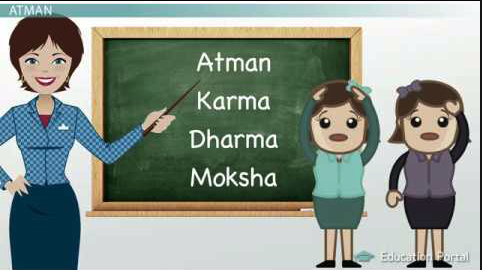
The basic tenets of Hinduism that all Hindus believe in are the concepts of:
- Dharma: Dharma is laws and order by which this universe is sustained. Dharma is the mode of conduct for an individual that is most conducive to spiritual advancement.
- Karma: We are responsible for our actions. Sometimes, we might not understand the events of life, but they are the sum total of our karma over multiple lifetimes. However, our past karma only decides some situations in life (prarabdha), we still have control over our karma in this lifetime, and all our life in this lifetime is not predestined.
- Atman/Soul: meaning that there is a light within each living being and that we are beyond our physical bodies. The Atman cannot be killed or destroyed, only the physical body can be destroyed.
- Kaal chakra (Samsara, Wheel of life): meaning that there is a continuous cycle of birth, death and rebirth.
- Moksha: That it is possible for human beings to realize their true nature and be one with their soul while in their physical body. Once the self realization happens, then one is said to attain moksha, and become free from the cycle of birth and death.
Other reading material:
Relevant videos:
Contributor: Swati Sugandhi
URL link of this page (5b): https://www.hinduspeakers.org/ufaqs/what-are-basic-tenets-of-hinduism/
Category:
05. Traditions
06. Life Goal
Aim of Human life is known as Purushartha (endeavours), “goals of human existence” or “the Atma’s purpose.” The Hindu Human Pursuit is a progression through the four endeavors – Dhama, Kama, Artha, and Moksha.
Dharma is the right way of living, being conscious in your actions, words and thoughts and living a life that is lawful and harmonious.
Kama is desire. We cannot live without a desire or a goal in life. Desire should follow Dharma.
Artha is money. Money is an important goal in human life and should be earned according to Dharma and is best when utilized towards Moksha.
The ultimate goal for a human life is to attain Moksha, which means liberation from the cycle of birth and death.
Other reading material:
Relevant videos: Swami Nikhil Anand Hinduism Q & A: What is the aim of life?,
Contribution: Geetha Ravula
Location of this file (6a): https://www.hinduspeakers.org/ufaqs/what-is-the-goal-of-human-life/
Category:
06. Life Goal
09. Dharma
Dharma is not the same as religion. Dharma has the Sanskrit root dhri, which means, “that which upholds”, “that without which nothing can stand” or “that which maintains the stability and harmony of the universe.” Dharma is often translated as laws and order by which this universe is sustained.
This dharma is not only limited to human beings. Fire’s dharma is to burn and a tree’s dharma is to bear fruits. This dharma principle also applies even to an inert material, like an electron’s dharma is to constantly moving in an orbit around proton and neutron. The day electrons decide to be a-dharmic and stop moving in that orbit, the world will fall apart in a second.
Dharma is the mode of conduct for an individual that is most conducive to spiritual advancement. Dharma encompasses ethics, morality, natural laws, conduct, etc. that is the most harmonious and aligned way to live as a society and on this planet. Dharma is, therefore, a conduct according to principles of universal order, social and moral conduct, that is righteous and takes an individual closer to divinity.
Abrahamic traditions are looking for a moral code. Dharma is searching for T/truth.
.Other reading material: Short answers to real questions about Hinduism, Rajiv Malhotra: Dharma is not the same as Religion, Rajeev Singh: What is Dharma?
Relevant videos: Swami Nikhilanand Hinduism Q & A: What Is Dharm,
Contributor: Dilip Amin
Location of this post (9a): https://www.hinduspeakers.org/ufaqs/what-is-dharma/
Category:
09. Dharma
- Whole world is one family. All have to live together, cooperate, assimilate and enjoy each other.
- Practice Ahimsa (non-cruelty) towards all living beings, because everybody has the right to live – “Live and Let Live”.
- Treat every human being like how you would like to be treated.
- God is one and there is nothing else but God. God is omnipresent, omnipotent and omniscient.
- God has created the whole universe and He is present in every particle of the universe.
- God is present everywhere, in all living beings – all humans, all animals, birds, insects. trees, etc. – and in all non-living objects like rivers, oceans, hills etc. and, therefore, everything is worship-able.
- Hindu Dharma is an open minded religion not bound by any incontrovertible pronouncements and rituals.
- Hinduism is not a dogmatic religion. There are no binding rituals and everyone is free to follow or not to follow any particular ritual.
- Hindu Dharma welcomes and accepts noble thoughts from all around the world.
- Hindu Dharma respects all religions and accepts their good points.
- Hindu Dharma believes in non-violence, not to kill any person or animal etc. except in self defense.
- Hindu Dharma believes in moral and ethical values, respect for parents, teachers and elders and knowledgeable persons all around the world.
Other reading material:
Relevant videos
Contributor: Sudhir Gupta
Location of this post (9b): https://www.hinduspeakers.org/ufaqs/what-are-tenets-of-hindu-dharma/
Category:
09. Dharma
11. Commandments
Hinduism is a family of traditions that emphasizes personal experience and evaluation and thus, offers overarching guidelines rather than absolute lists of do’s and don’ts or commandments in regulating individual behavior. For a Hindu, all actions are to be guided by dharma. Hindu ethical values flow from one’s understanding of the nature of reality and inform the Hindu understanding of right and wrong.
To paraphrase Coco Chanel, “Fashion changes, Style is eternal”, Hindus would agree with “Commandments change, but Dharma is forever”.
.
Source: https://www.hinduamerican.org/hinduism-short-answers-real-questions
Relevant videos:
Location of this post (11a): https://www.hinduspeakers.org/ufaqs/do-hindus-have-commandments/
Category:
11. Commandments
12. Origin
Hinduism (vedic tradition) started with creation, when Brahma was handed the Vedas as the body of knowledge to administer the creation function in the Universe. In that, it exists beyond just earth in other life-sustaining planets in the Universe. Historically, on earth, it has existed since creation of life on earth.
The root of Hinduism is in Dharma. Dharma is a mix of morality, virtue, integrity, conduct, physical and metaphysical concepts. E.g. it’s the dharma of water to wet a material, as is the dharma of fire to burn, or the dharma of Earth to go around the Sun. Dharma has always existed. Therefore, the metaphysical underpinnings of Hinduism have always existed.
Politically speaking, the term Hindu became prevalent to describe the civilization that lived in the subcontinent between the Himalayas and Indian Ocean. The identity of the people was termed Hindu by the conquerors from the West–Romans, Turks, Arabs, Persians, Mongols, and the British.
Hinduism as a philosophy has been well-formed at least for 5000 years, it has moulded as a political identity only in the last 1000 years since the Islamic conquests of India started in about 1100 AD.
Other reading material: https://houseoflac.wordpress.com/2018/02/14/what-is-dharma/
Relevant videos
Contributor: Rajeev Singh
Location of this post (12d): https://www.hinduspeakers.org/ufaqs/in-what-historical-context-did-hinduism-emerge/
Category:
12. Origin
Yes. It happens when there is decay of dharma (see below) or righteousness in the world.
In Hinduism there is no finite end of the world – there is only the end of one phase followed by the beginning of the next. The world goes through many cycles of varying degrees of order, chaos, good vs. evil, and eventually all matter dissolves completely followed by a regeneration.
In Bhagwad Gita, Krishna advises Arjuna in chapter 4 verse 7:
“yadā yadā hi dharmasya glānir bhavati bhārata
abhyutthānam adharmasya tadātmānaṁ sṛijāmyaham”
“Whenever there is decay of dharma and rise of adharma, then I am born in this world”.
The current age is called Kali Yuga in Hinduism i.e. the age of darkness.
In the Hindu scripture the Bhagavatam the following is said in regard to Kali Yuga:
Srimad Bhagavatam 12.2.1:
“Sri-suka uvaca…tatas canu-dinam dharmah…satyam saucam ksama daya…kalena balina rajan…nanksyaty ayur balam smrtih”.
“Religion, truthfulness, cleanliness, tolerance, mercy, duration of life, physical strength and memory will all diminish day by day because of the powerful influence of the age of Kali..“
Srimad Bhagavatam 12.2.2:
“vittam eva kalau nṝṇāḿ…janmācāra-guṇodayaḥ…dharma-nyāya-vyavasthāyāḿ…kāraṇaḿ balam eva hi”.
“In Kali Yuga, wealth alone will be considered the sign of a man’s goodness, behaviour and fine qualities. And law and justice will be applied only on the basis of one’s power.“
According to Hindu scriptures God will incarnate in the form of a human named Kalki to save it from destruction and restore order. Keeping in mind this is not the first kaliyuga and will not be the last one.
Dharma
Dharma is one of the most important words in Hinduism and does not have a good English equivalent. A rough meaning is righteousness or virtue, it can also mean “law” “custom” “one’s duty”. It comes from the Sanskrit root dhri (which means “to support,” or “to maintain”), dharma is described in early Vedic texts as laws that bring order to a universe that would otherwise be in chaos.
Dharma refers to actions most conducive to maintaining family and society. Dharma starts at the individual level if the individuals are righteous and following good morals, then the family will be stable if the family is stable then the society will thrive. If that is not the case, i.e. if there is adharma, then chaos and destruction will rule.
Important to note that laws, duties, and customs shift and change from person to person, culture to culture, place to place, and time period to time period. Because all people are unique with different inclinations and responsibilities, determining the “right” or “proper” actions a person should perform from moment to moment requires a lot of self reflection.
Other reading material:
Relevant videos
Contributor: Bijay Nair
Location of this post (12e): https://www.hinduspeakers.org/ufaqs/will-the-world-comes-to-an-end/
Categories:
02. God Forms
12. Origin
19. Hindu Life
Hindus have an ethics framework and recommendations but do not have the commandments. They rather have the do’s and don’ts–ten of each. These are called the yamas (restraints) and niyamas (practices). Collectively, these are the code of conduct for Hindus. Restraints are non-injury, truthfulness, non-stealing, divine conduct, patience, compassion, steadfastness, honesty, purity, and moderate appetite. Practices are observances that are a derivative of the restraints. Hindu Ethics are enshrined in the Vedas and Smritis. They were also practically demonstrated by God Himself in the Itihasas and Puranas. Hindu ethics are rooted in these 10 restraints.
Other reading material: https://houseoflac.wordpress.com/2020/09/06/25-yama-and-niyama/
Relevant videos
Contributor: Rajeev Singh
Location of this post (19e): https://www.hinduspeakers.org/ufaqs/what-are-hinduisms-ethical-and-legal-rules/
Category:
19. Hindu Life