Simple answers to your questions on Hinduism are provided here.
Use the search button (top right on desktop, top left on smartphones) to find specific topics of interest. At the bottom of each answer, check the “Tags” section for related topics. To learn more about this Q&A project, click [here].


On Hinduism
You can also download an earlier collection: 300QAs on Hinduism (PDF). Thank you.
03. General
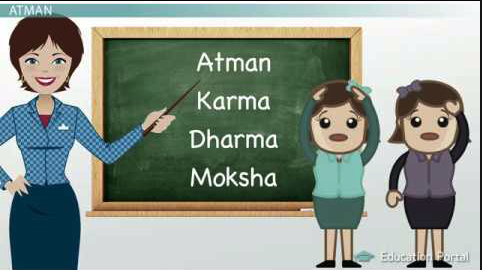
Hinduism or Sanatana Dharma (Eternal Path) is the oldest religion and it originated in the Indian subcontinent (current day India-Pakistan-Bangladesh-Afghanistan-Nepal-Bhutan). It is a sum total of various Indic philosophies and ways of life of the people in the Indian subcontinent. Even though the cultural values vary among different traditions within Hinduism, the common threads of four values binds all the traditions together:
Dharma: The law of the cosmos/true path. On an individual level, one’s personal duty.
Karma: Action (Papa and Punya)
Sansara: Cycle of life (birth-death-rebirth)
Moksha: Liberation of the soul (Atma) from Sansara (the cycle of life and death)
Other reading material:
Relevant videos:
Contributor: Swati Sugandhi
Location of this post (3f): https://www.hinduspeakers.org/ufaqs/how-is-hinduism-defined/
Category:
03. General
05. Traditions
The basic tenets of Hinduism that all Hindus believe in are the concepts of:
- Dharma: Dharma is laws and order by which this universe is sustained. Dharma is the mode of conduct for an individual that is most conducive to spiritual advancement.
- Karma: We are responsible for our actions. Sometimes, we might not understand the events of life, but they are the sum total of our karma over multiple lifetimes. However, our past karma only decides some situations in life (prarabdha), we still have control over our karma in this lifetime, and all our life in this lifetime is not predestined.
- Atman/Soul: meaning that there is a light within each living being and that we are beyond our physical bodies. The Atman cannot be killed or destroyed, only the physical body can be destroyed.
- Kaal chakra (Samsara, Wheel of life): meaning that there is a continuous cycle of birth, death and rebirth.
- Moksha: That it is possible for human beings to realize their true nature and be one with their soul while in their physical body. Once the self realization happens, then one is said to attain moksha, and become free from the cycle of birth and death.
Other reading material:
Relevant videos:
Contributor: Swati Sugandhi
URL link of this page (5b): https://www.hinduspeakers.org/ufaqs/what-are-basic-tenets-of-hinduism/
Category:
05. Traditions
06. Life Goal
Aim of Human life is known as Purushartha (endeavours), “goals of human existence” or “the Atma’s purpose.” The Hindu Human Pursuit is a progression through the four endeavors – Dhama, Kama, Artha, and Moksha.
Dharma is the right way of living, being conscious in your actions, words and thoughts and living a life that is lawful and harmonious.
Kama is desire. We cannot live without a desire or a goal in life. Desire should follow Dharma.
Artha is money. Money is an important goal in human life and should be earned according to Dharma and is best when utilized towards Moksha.
The ultimate goal for a human life is to attain Moksha, which means liberation from the cycle of birth and death.
Other reading material:
Relevant videos: Swami Nikhil Anand Hinduism Q & A: What is the aim of life?,
Contribution: Geetha Ravula
Location of this file (6a): https://www.hinduspeakers.org/ufaqs/what-is-the-goal-of-human-life/
Category:
06. Life Goal
13. Heaven and Hell
Moksha means liberation; it’s the concept of ultimate freedom from the cycle of life and death.
Hindus believe that there is no death for the soul or atman. When the soul leaves this body it passes through a cycle of successive lives. Its next incarnation is always dependent on past deeds. Without ultimate liberation, we reincarnate again and again in the form of human or any other living being. This cycle of life and death can only be broken when a soul attains Moksha.
Moksha is one of the human pursuits and it can be achieved when a human being pursues self-realization. It is achieved by ending false ego and desires. Moksha is attained only when all good and bad karmas of many lifetimes are exhausted and God is fully realized.
.
Other reading material: HAF: What is moksha?
Relevant videos: Swami Nikhil Anand Swami Nikhil Anand: What Is Liberation
Contributor: Geetha Ravula
Location of this post (13c): https://www.hinduspeakers.org/ufaqs/what-is-moksha/
Category:
13. Heaven and Hell
According to Biblical scholar Bart Ehrmann, Jesus didn’t preach about Heaven or Hell. These are later interpolations and misunderstandings that are glorified in modern religious dialog.
Hindus do believe there is a “place of no-anxiety” (Vaikuntha), which is the highest realm and the home of Vishnu, the creator. This is the place of no-anxiety, as the name suggests, but we do not live there as our currently embodied selves. In the Hindu tradition, our current bodies are like clothing that we wear and discard, while our inner self, Atman, is the one that continues the onward journeys. Relationships made by this physical body are also considered, therefore, impermanent.
There are lower realms that correspond a little more closely with the modern Christian concept of heaven or hell, except we don’t have harps and virgins. These realms are also meant for enjoyment of the results of our actions (if good, you go to the higher realm, and if bad, well, no soup for you, and you go to the lower realm). But this isn’t permanent. When you have done your time, you can return back to this physical realm, and start counting up your deeds again.
Hindus are more likely to interpret Jesus’ teaching of the “Kingdom of God” (which he talked extensively about), as a reference to the heart filled with devotion (and not to heaven, as such). Hindus would agree that God lives in our hearts filled with love. And if you can find your way to your heart, you are in a place of no-anxiety, or heaven.
Welcome home, to your own heart!
.
Other reading material:
Relevant videos: Swami Nikhilanand Heaven in Hinduism, is it the same as in Christianity?, Hell in Hinduism, is it the same as in Christianity?, Bart Ehrmann’s interview on NPR
Contributor: Gaurav Rastogi
Location of this post (13d): https://www.hinduspeakers.org/ufaqs/is-heaven-in-hinduism-the-same-as-christianity/
Category:
13. Heaven and Hell
15. Reincarnation
Hinduism does not teach ideas such as eternal Heaven or Hell. It sees life as a process of evolution where we grow spiritually over many lives.
Behavior in a past life, combined with dharma (the duty you are born with) for this life, creates the lives we live in the present.
With each incarnation we get new lessons, based on what lessons we passed and failed in the last life. If you were an abusive person in a past life, your karma dictates you will be on the receiving end of abuse in this or future lives. Forgiving your abuser where appropriate, and asking for forgiveness for yourself, frees you from the karma.
When an Atman persists in not learning lessons, abusing, not forgiving; a vicious cycle of birth and death is created until the Atman evolves and attains moksha (liberation from the cycle of birth and death).
Other reading material: The Momentum of Karma
Relevant videos: Swami Nikhil Anand Hinduism Q & A: What is Good Action, Why I become Hindu, Transcending Karma, The Deeper Meaning of Dharma,
Contributor: Swamini VishwaPratibha
Location of this page (15c): https://www.hinduspeakers.org/ufaqs/c-how-much-has-ones-past-life-had-an-impact-on-the-current-life/
Category:
15. Reincarnation
16. Soul/Atman
According to Hindu scriptures, there is no death for the Atman (soul is a wrong term). The human Atman (jīvātma) is considered to be of the same essence as the Divine Supreme Atman (paramātma), also termed as Consciousness. Hence the Atman, in the Hindu context, is eternal, imperishable, changeless, and that which illumines everything.
The Atman can be thought of as a source of light. While the furniture in a room might keep changing, the reason one can see and experience these items is due to the presence of the light. Similarly, we are able to perceive, feel and think in the world because of our soul.
Lord Krishna declares in the Bhagavad Gita, Chapter 2, Verse 20:
na jāyate mriyate vā kadāchin nāyaṁ bhūtvā bhavitā vā na bhūyaḥ
ajo nityaḥ śhāśhvato ’yaṁ purāṇo na hanyate hanyamāne śharīre
The Atman is neither born, nor does it ever die; nor having once existed, does it ever cease to be. It is without birth, eternal, immortal, and ageless. The Atman is not destroyed when the body is destroyed.
Thus, Hindu theologians conclude that the Atman does not die. When a person passes on, their body decays, mind stops thinking, but the Atman, however, continues to exist. It leaves the body and moves onto a different realm of experience, based on what that particular Atman needs for evolution. This is valid for all living beings, and not just humans. It is due to this belief system that Hindus propound the theory of karma and reincarnation. The Atman evolves by taking on different births, until it reaches spiritual maturity and finally merges with the Divine Consciousness. This, liberation (moksha), is the goal of life on earth.
Other reading material: Reincarnation: WHO is it that Travels? Atma? Jiva? Subtle body?
Relevant videos: Swami Nikhil Anand Hinduism Q & A: What happens when we die?, Hinduism Q & A: Can the soul die?, Hinduism Q & A: What is Reincarnation?,
Contributor: Lakshmi Subramanian
Location of this post (16b): https://www.hinduspeakers.org/ufaqs/can-the-soul-die/
Category:
16. Soul/Atman
23. Yoga and Meditation
Meditation (dhyana) in Hinduism is a practice that helps you become the master of your mind, body, and emotions. Your mind, body, and emotions are your tools. You are meant to be in charge of them, not the other way around.
There are many ways to meditate, for example: OM/AUM chanting, chakra meditation, focussing on one’s ishtadev (who you identify as God) such as Lord Krishna with Hare Rama Hare Krishna mahamantra, singing devotional songs and so on. The the goal is the same: moving beyond your mind-body-emotions and ultimately realizing God and the true nature of your soul (moksha).
Other reading material: Purpose of meditation, Sadhguru-Yoga for Beginners , How do I meditate #78
Relevant videos: https://www.youtube.com/watch?v=uGosHULQQk0, Hinduism Q & A: What is Meditation ,
Contributor: Swati Sugandhi
Location of this post (23d): https://www.hinduspeakers.org/ufaqs/what-is-meditation/
Category:
23. Yoga and Meditation